Unimasters | 25/06/2026

Series
Green Corridor: ESG & Sustainability in BESS Logistics
Every BESS project placed on the EU market after 18 August 2025 carries a legal obligation for end-of-life management that begins at the moment of import. The producer (defined under Article 3 of the EU Battery Regulation as the entity first placing the battery on the EU market) assumes Extended Producer Responsibility (EPR) for collection, treatment, and recycling. For most CEE BESS projects, that producer is the EPC company or the asset owner, not the manufacturer in China.
This is not a future compliance problem. It is a current procurement decision. The logistics infrastructure for returning 35–45 ton BESS containers from a Bulgarian or Romanian site to a recycling facility does not yet exist at scale. The contracts signed today will determine whether that infrastructure is available in 2036.
The EU Battery Regulation sets specific material recovery targets that define what recycling actually means for BESS:
Material Recovery Targets (Article 71, Annex XII):
Recycling Efficiency Targets:
For a typical 230 MWh BESS installation using LFP (lithium iron phosphate) chemistry, the lithium recovery target is the binding constraint. LFP batteries contain no cobalt or nickel, making them less economically attractive for recyclers focused on high-value metal recovery. The 80% lithium recovery target by 2031 will require hydrometallurgical processing that most European recyclers are still scaling.
Carbon Footprint Declaration Timeline:
The carbon footprint of reverse logistics, specifically the transport of end-of-life batteries from site to recycler, must be included in lifecycle assessments. For a BESS facility 400 km inland from Burgas, the reverse logistics leg adds measurable emissions that will appear in ESG reporting.
EU Battery Regulation 2023/1542 is the governing instrument. Key articles for BESS reverse logistics:
Extended Producer Responsibility (EPR) under the regulation requires producers to:
For BESS projects in Bulgaria, Romania, or other CEE countries, this means identifying and contracting with a PRO before the first container arrives at port. The PRO landscape in CEE is still developing; Germany's REBAT system (with over 65,500 collection points) is mature, but equivalent infrastructure in Bulgaria or Romania is limited.
ADR 2025 governs the road transport of end-of-life BESS containers. Waste lithium batteries are classified under:
The critical distinction: a BESS container at end-of-life is not automatically damaged or defective. If the battery modules have simply degraded below economic viability (typically 70–80% of original capacity) but remain structurally sound, standard UN3480 classification applies. If thermal events, physical damage, or cell failures have occurred, the stricter P908/P911 packaging requirements apply.
Under Article 3(33) of the EU Battery Regulation, the producer is the entity that first places the battery on the EU market. For BESS imports from China:
This determination must be made before customs clearance. The producer designation cannot be transferred retroactively.
PRO registration is required in each Member State where batteries are placed on the market. For a BESS project in Bulgaria:
From 18 February 2027, every industrial battery >2 kWh must have a digital battery passport accessible via QR code. The passport must include:
The data structure must be established at commissioning, not at end-of-life. The Battery Management System (BMS) must be configured to log the data required for the passport from day one.
End-of-life BESS containers must travel from the installation site to a licensed treatment facility. For CEE projects, the options are:
The transport classification depends on battery condition:
For a 43-ton BESS container, overweight permits will be required for road transport. The same permit process that applied to inbound delivery applies to outbound removal: 6–8 working days for single-country permits, 8–12 working days for multi-country routes.
Industry estimates place BESS decommissioning costs at approximately 5–6% of original CAPEX. The cost breakdown:
For LFP batteries, recycling economics are challenging. Unlike NMC batteries (which contain valuable cobalt and nickel), LFP batteries have lower intrinsic material value. Recyclers may charge a gate fee rather than pay for LFP feedstock. This cost must be included in project financial models.
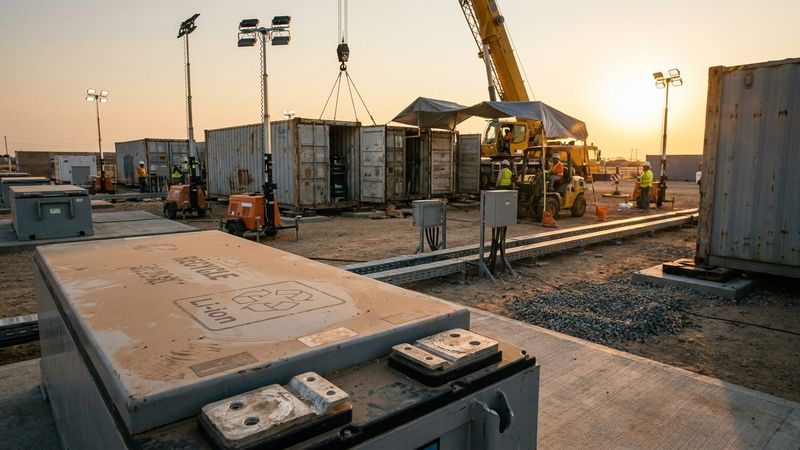
The recycling symbol that will define Europe's energy transition economics.
Repurposing BESS batteries for second-life applications (such as lower-demand stationary storage) is technically viable and environmentally beneficial. The EU Battery Regulation explicitly supports second-life through Article 14, which requires BMS data access for independent operators assessing repurposing potential.
The trap: second-life does not eliminate EPR obligations. The producer remains responsible for the battery until it reaches final recycling. If a second-life operator takes possession and subsequently fails to manage end-of-life properly, the original producer retains liability.
Second-life is a delay mechanism, not an exit strategy. The reverse logistics infrastructure must still exist when the second life ends.
Some recyclers market carbon-neutral or net-zero recycling services. The EU Battery Regulation requires carbon footprint declarations based on specific methodology (to be defined in delegated acts). Generic carbon-neutral claims without methodology disclosure do not satisfy regulatory requirements.
The test: can the recycler provide batch-level mass balance data showing material recovery rates by element? If not, the claim is marketing, not compliance.
PRO membership ensures collection infrastructure. It does not guarantee recycling efficiency or material recovery rates. The producer must verify that the PRO's downstream treatment partners can meet the 2027 and 2031 recovery targets.
A PRO that collects batteries but sends them to facilities achieving only 50% lithium recovery will leave the producer non-compliant with 2031 targets.
For EPC teams currently in procurement for BESS projects with 2026–2027 commissioning targets:
Q: Who is legally responsible for BESS end-of-life management under EU law?
A: The producer as defined in Article 3(33) of EU Battery Regulation 2023/1542, which is the entity that first places the battery on the EU market. For most CEE BESS projects importing from China, this is the importer of record, typically the EPC company or asset owner.
Q: When does the Digital Battery Passport become mandatory for BESS?
A: 18 February 2027 for industrial batteries with capacity greater than 2 kWh. The passport must be accessible via QR code and contain carbon footprint, recycled content, state of health data, and end-of-life information.
Q: What are the lithium recovery targets for BESS recycling?
A: 50% lithium recovery by 31 December 2027, increasing to 80% by 31 December 2031. These targets apply to the recycling facility processing the waste batteries, but the producer is responsible for ensuring compliance.
Q: How are end-of-life BESS containers classified for road transport?
A: Intact, degraded batteries are classified as UN3480 (lithium-ion batteries), Class 9 dangerous goods under ADR. Damaged or defective batteries require stricter packaging under P908 or P911 instructions.
Q: What is the estimated cost of BESS decommissioning?
A: Industry estimates place decommissioning costs at approximately 5–6% of original project CAPEX, with recycling/treatment accounting for roughly 70% of that cost. LFP batteries may incur gate fees due to lower material value.
Q: Does repurposing batteries for second-life applications eliminate EPR obligations?
A: No. The original producer retains Extended Producer Responsibility until the battery reaches final recycling. Second-life delays but does not eliminate the obligation.
Q: What PRO registration is required for a BESS project in Bulgaria?
A: The producer must register with an approved Producer Responsibility Organisation in Bulgaria before placing batteries on the market. The list of approved PROs is maintained by the Bulgarian Ministry of Environment and Water. Registration must occur before the first shipment clears customs.

