

After Delivery: From Quay to Commissioning – The Final 72 Hours That Define Your Project
Series
8,000 km in 45 Days: BESS Logistics from China to CEE
- Ep. 1 · Origin - Where the Journey Begins
- Ep. 2 · At Sea - The Maritime Leg
- Ep. 3 · At the Borders - Customs Clearance in CEE
- Ep. 4 · Oversized - 43 Tonnes on the Roads of CEE
- Current episode: Ep. 5 · After Delivery - From Quay to Foundation
- Ep. 6 · Insured? Cargo Insurance
The Situation
The containers have cleared customs at the Port of Burgas. The transport documents are in order, the ADR declarations are valid, and the heavy-haul trailers are waiting at the terminal. Now begins the final physical stage of the logistics chain: moving 40+ containers weighing around 43 tonnes each from the port terminal to the construction site and positioning them on the prepared foundations.
This is the moment when logistics hands the baton to construction – and where mistakes from earlier stages materialise as real delays.
What You Are Really Dealing With
The Last Mile: From Terminal to Site
Port-to-port transit time – whether 35 or 65 days – ends at the quay. From there, inland delivery begins. It is not included in sea-transit time and requires separate planning.
Heavy road transport under ADR 2025:
- BESS containers (20' HC, around 43 tonnes gross) are treated as UN3536 for transport planning.
- State of Charge (SoC) is kept at ≤30%, consistent with the maritime transport condition used for the IMDG leg.
- Placarding: Class 9 placards and the UN number on all four sides of the container – left, right, front and rear.
- The driver must hold a valid ADR qualification for Class 9.
- The vehicle must carry the required ADR equipment, including fire extinguishers, warning equipment and written instructions.
Oversized-load permits:
For containers above 40 tonnes gross – a typical BESS container is around 43 tonnes – an oversized-load permit is required. The source gives a normal lead time of 5–10 working days, extending to as much as 15 days for complex routes involving bridges, tunnels or urban areas.
Route survey:
Before the permit application, a route survey should identify:
- Bridges with axle-load restrictions
- Roundabouts with insufficient turning radius
- Overpasses with restricted height
- Road sections with time-of-day traffic restrictions
Preparing the Construction Site
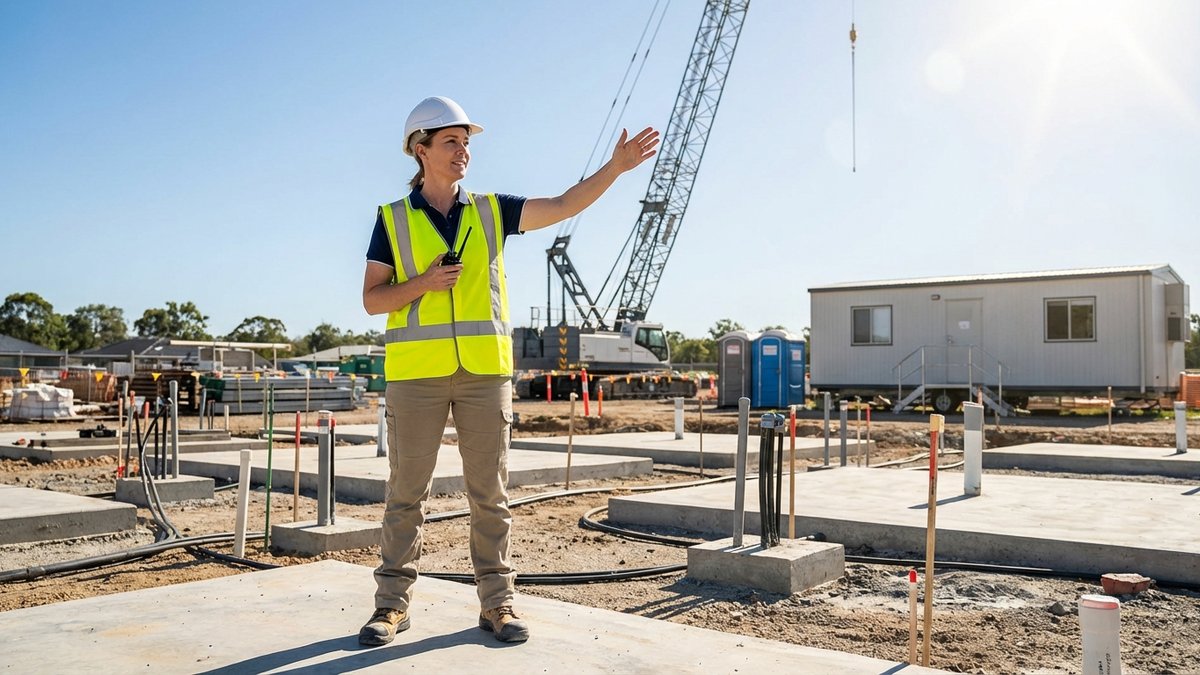
Before the first container arrives, the construction site should meet the following requirements:
Access and manoeuvring area:
- The site entrance should accommodate heavy-haul trailers up to 18 metres long.
- Turning radius should be at least 15 metres for standard configurations.
- Temporary roads should support at least 12 tonnes per axle.
- In poor weather such as rain or snow, temporary roads can become impassable – a frequent cause of delay in autumn and winter.
Foundations:
- Concrete foundations should be complete and have reached their design strength before containers are positioned.
- The coordinates of each foundation should match the layout plan supplied by the system integrator.
- Anchor bolts should be installed to an accuracy of ±5 mm.
Crane pad:
- The crane area should be levelled and compacted.
- Soil bearing capacity should be confirmed by a geotechnical report.
- For a 100+ tonne mobile crane, the pad should withstand outrigger loads typically around 20–25 tonnes per outrigger.
Unloading and Positioning
Crane operations:
Unloading BESS containers requires a mobile crane with at least 100 tonnes of lifting capacity for containers around 43 tonnes, providing an appropriate safety margin. Key considerations include:
- Lifting points are defined by the manufacturer. Lifting from unapproved points can deform the frame or damage internal components.
- The sling angle should be at least 60° to the horizontal.
- Lowering speed should be controlled; sudden lowering can damage battery modules.
Unloading sequence:
Containers should be unloaded in a sequence aligned with the installation plan. Unloading in arbitrary order can block access to foundations that need to be occupied first.
Site Acceptance
Once the containers are positioned, site acceptance begins and includes:
Visual inspection:
- Check for visible transport damage such as dents, scratches and deformation.
- Check door seals and ventilation openings.
- Check labels and markings.
Document check:
- Compare container serial numbers against the Packing List.
- Check the completeness of the delivery against the Commercial Invoice.
Photo documentation:
Each container should be photographed from all four sides. This record is critical for any later insurance claim.
The Timeline
| Stage | Typical duration | What determines the range |
|---|---|---|
| Customs clearance in Burgas | 1–3 working days | Document completeness, customs workload |
| Oversized-load permit, arranged in advance | 5–10 working days | Route complexity, number of municipalities involved |
| Inland transport to site | 1–2 days per batch | Distance, traffic restrictions |
| Unloading and positioning | Up to 10 containers per day | Crane availability, weather |
| Site acceptance, visual + documentary | 1–2 days | Number of containers, staff availability |
Total for 40 containers: around 10–15 working days from quay to completed positioning.
Where procurement managers consistently underestimate:
- The permit lead time – the application should be filed at least two weeks before the planned transport date.
- Weather dependency – rain can stop crane operations for days.
- Coordination between the logistics operator and the construction team – an unready site is a common cause of terminal storage charges.
The Documents
Documents Required for Inland Transport
| Document | Prepared by | Format | Common errors |
|---|---|---|---|
| ADR transport document | Freight forwarder or carrier | Paper, in the cab | Wrong UN number, e.g. UN3480 instead of UN3536 |
| Oversized-load permit | Carrier through the relevant authority | Electronic + paper | Mismatch between declared and actual weight |
| Written ADR instructions | Manufacturer or freight forwarder | Paper, in the required languages | Missing local-language version |
| Domestic or CMR consignment note | Carrier | Paper | Wrong delivery address |
Documents for Site Acceptance
| Document | Prepared by | What it contains |
|---|---|---|
| Delivery Receipt | Construction manager | Receipt confirmation and damage remarks |
| Photo documentation | Construction team | Photos of each container from four sides |
| Visual inspection checklist | Construction manager | Systematic condition check |
What Goes Wrong
Scenario 1: The Oversized-Load Permit Is Not Ready
What happens: the containers are released by customs, but the oversized-load permit has not yet been issued. The application was only filed after the vessel arrived.
Why: the procurement team assumed the permit could be obtained in 2–3 days. In reality, the route crosses three municipalities and requires coordination with each one.
Consequences: the containers remain at the terminal for an additional 10 days. Storage charges accumulate and the construction schedule slips.
Prevention: file the permit application at least 2–3 weeks before the expected customs-clearance date. Complete the route survey before filing.
Scenario 2: The Construction Site Is Not Ready
What happens: the containers arrive at the site, but the foundations are incomplete. The concrete was poured only five days earlier and has not reached design strength.
Why: the construction schedule was too optimistic. Bad weather delayed concreting by two weeks.
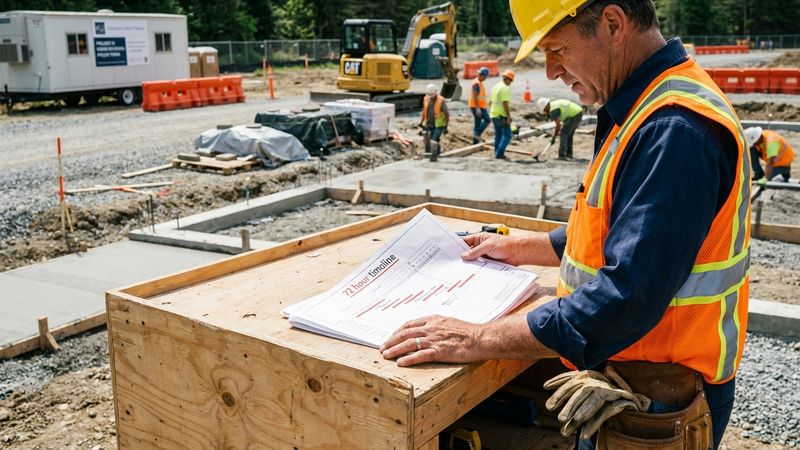
The difference between theoretical timelines and reality reveals itself in these final hours.
Consequences: containers must be stored temporarily on site or returned to the terminal. This adds crane mobilisation/demobilisation costs, extra road transport and a greater risk of damage from double handling.
Prevention: include a buffer of at least two weeks between foundation completion and container arrival. Confirm site readiness 72 hours before planned arrival.
Scenario 3: Weight Mismatch at Unloading
What happens: a container is weighed at 44.2 tonnes while the Packing List states 42.8 tonnes. The oversized-load permit was issued for 43 tonnes.
Why: the manufacturer used standard-specification weight and did not account for additional securing elements. VGM showed the higher actual weight, but the Packing List was never updated.
Consequences: the permit is not valid for the actual weight. The movement is technically non-compliant, creating a risk of fines and delivery delay.
Prevention: align the Packing List with actual VGM weight before the Bill of Lading is issued. The source recommends applying for the oversized-load permit with a +5% margin over the declared weight.
Scenario 4: Damage Discovered After Positioning
What happens: during preparation for Site Acceptance Testing, visible deformation and damaged protruding cables are found on one side of a container. No photo documentation was made at vessel discharge or truck loading.
Why: the customer's team did not require a survey with visual inspection at the discharge port.
Consequences: it is impossible to prove when the damage occurred – during transport, unloading or manufacturing. The insurance claim is disputed and commissioning is delayed.
Prevention: arrange an inspection of all sides of the container, including top and underside where feasible, at vessel discharge or at the latest during truck loading at the terminal.
Scenario 5: Wrong Unloading Sequence
What happens: containers are unloaded in arrival order rather than installation order. A container intended for the back of the site is positioned at the front and blocks access.
Why: there was no coordination between the logistics operator and construction manager. The layout plan was not shared with the terminal team.
Consequences: already-positioned containers have to be moved again, adding crane hours and increasing the risk of damage through double handling.
Prevention: share the layout plan with the logistics operator and require delivery in the necessary sequence. Agree the unloading sequence in writing.
What This Means for Your Project
- Ask the forwarder/carrier to start the oversized-load permit process at least two weeks before expected customs clearance. Complete route assessment before filing. For routes crossing more than two municipalities, allow more time.
- Confirm site readiness 72 hours before planned arrival. Check foundations, access and crane pad.
- Agree the unloading sequence with the logistics operator at least one week in advance. Share the layout plan and container numbers that must arrive first.
- Document the condition of every container on arrival. Photograph all sides and sign a delivery record. This is essential evidence for insurance claims.
- Plan at least a two-week buffer between foundation completion and container arrival. Concrete must reach design strength and weather can delay construction work.
What to Remember
- Transit time ends at the quay, not at the construction site. Inland delivery and positioning add around 10–15 working days.
- The oversized-load permit is on the critical path. A late permit blocks the chain while containers sit at the terminal and storage charges accumulate.
- Site readiness belongs to construction, but the impact of an unready site is felt by the whole project. Logistics and construction should coordinate weeks before arrival.
- A survey at port discharge or truck loading, followed by another condition check at site, is essential evidence in damage disputes and insurance claims.
- Unloading sequence matters. The wrong order can force double handling, adding cost and risk.
Frequently Asked Questions
Q: How long does an oversized-load permit take in Bulgaria?
A: The source gives a typical lead time of 5–10 working days, depending on route complexity and the number of municipalities involved.
Q: What crane is needed to unload BESS containers weighing around 43 tonnes?
A: The source recommends a mobile crane with at least 100 tonnes of lifting capacity to provide an appropriate safety margin. The exact configuration depends on working radius and lift height, and a lift plan should be prepared before the operation.
Q: What ADR requirements apply to road transport of BESS containers?
A: The source uses UN3536 and calls for the ≤30% SoC transport condition, Class 9 placards on all four sides, an ADR-qualified driver, written instructions in the cab and ADR-compliant vehicle equipment.
Q: What should the visual inspection at site acceptance include?
A: Visible damage such as dents, scratches and deformation; door and ventilation seals; labels and markings; and serial-number matching against the Packing List. Photograph each container from four sides before positioning.
Q: What happens if the site is not ready when the containers arrive?
A: Containers need temporary storage either on site or back at the terminal. Both options add storage, crane and transport costs and increase the risk of damage from additional handling. Confirm readiness 72 hours before arrival.
Q: How should damage discovered at site be documented?
A: Record it in the Delivery Receipt, include a description, location, photographs and discovery time, and notify the relevant insurer/logistics parties promptly.
Q: What is typical unloading productivity?
A: Under good conditions, the source indicates roughly 10–12 containers can be unloaded and positioned per day, depending on crane setup, positioning complexity and whether the crane must move between positions.