

At Sea: The Maritime Leg of BESS Transport
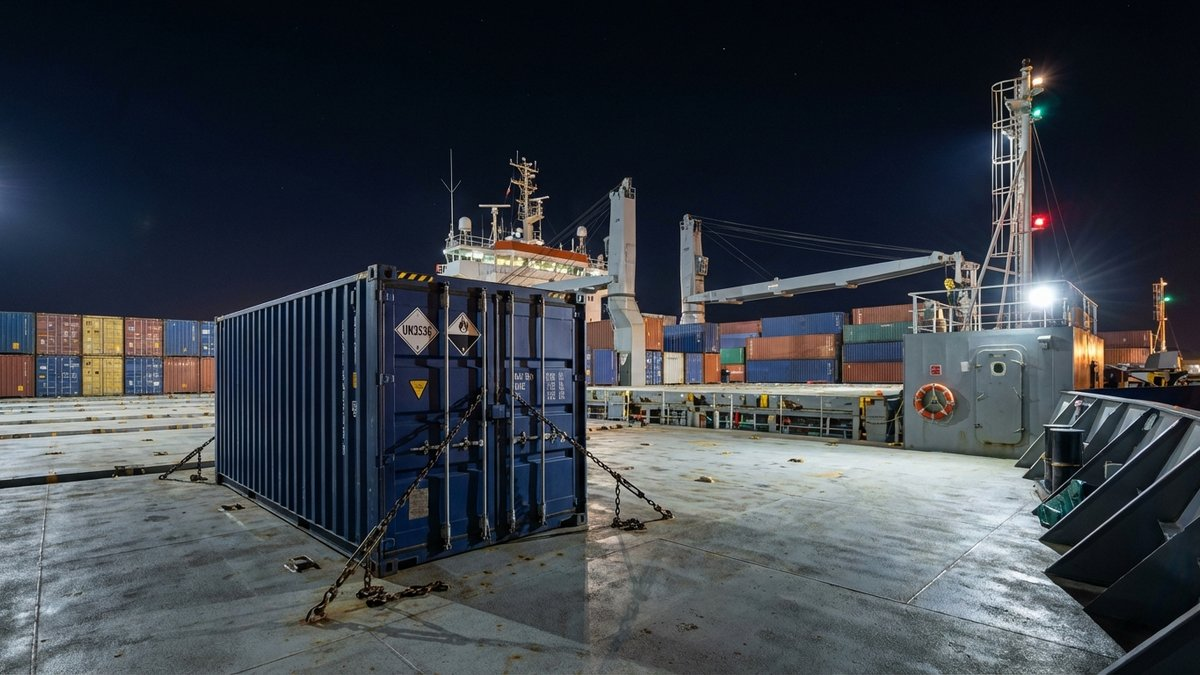
At Sea: 28–65 Days When Control Is Out of the Procurement Team's Hands
Unimasters | 02/04/2026
Series: 8,000 km in 45 Days: BESS Logistics from China to CEE
Ep. 1 · Origin - Where the Journey Begins
Current episode: Ep. 2 · At Sea - The Maritime Leg
Ep. 3 · At the Borders - Customs Clearance in CEE
Ep. 4 · Oversized - 43 Tonnes on the Roads of CEE
Ep. 5 · After Delivery - From Quay to Foundation
Ep. 6 · Insured? Cargo Insurance
The Situation
The containers have been loaded onto a vessel at a Chinese port – Ningbo, Shanghai or Yantian. The dangerous-goods documentation has been accepted by the carrier, the VGM declaration has been filed and the booking is confirmed. From this point onward, the shipment enters the maritime leg – the longest part of the logistics chain and the period in which the procurement team has the least control over the cargo's physical movement.
Sea transit to Black Sea ports such as Burgas, Varna and Constanța takes between 28 and 65 days depending on the selected route and carrier. This is the period when mistakes made in earlier stages surface – and when delays can compound exponentially.
What You Are Really Dealing With
Classification and Sea-Transport Requirements
BESS containers are classified as UN3536 – Lithium batteries installed in a cargo transport unit – under IMDG Code Amendment 42-24, mandatory from 1 January 2026. This is Class 9 dangerous goods with Stowage Category D, meaning on deck only.
Key regulatory requirements:
State of Charge (SoC): batteries should be at no more than 30% of nominal capacity for sea transport. This reduces the risk and severity of thermal runaway and is a standard carrier requirement.
Placarding: Class 9 placards and UN-number markings are required on all four sides of the container – left, right, front and rear.
Documentation: Shipper's Declaration for Dangerous Goods, UN38.3 Test Summary and MSDS/SDS, all supplied by the manufacturer.
Route Options to the Black Sea
As of April 2026, there are two main routing options:
Option 1: Direct services through the Suez Canal
Transit time: ~30–35 days to Constanța/Burgas
Frequency: 1–2 sailings per month
Offered by niche carriers
Advantage: shorter transit time
Disadvantage: irregular sailings and harder planning
Option 2: Cape of Good Hope (COGH) routing with transshipment
Transit time: ~55–70 days to Constanța/Burgas
Frequency: weekly sailings from major carriers
Transshipment in Piraeus (Greece) or Istanbul (Türkiye); Tekirdağ is an alternative used by MSC
Advantage: regularity and reliability of sailings
Disadvantage: substantially longer transit time
The routing decision is made at booking based on the carrier's announced service – not at the last minute. COGH routing is selected for reliability and regularity, not because the Suez Canal is necessarily unavailable.
Transshipment and Feeder Connections
For most BESS shipments bound for Black Sea ports, transshipment is unavoidable. Piraeus and Istanbul are the dominant hubs; Tekirdağ is an alternative used by MSC.
Critical point: feeder connections are arranged by the carrier as part of the end-to-end booking. The freight forwarder does not book feeders separately. Feeders to Burgas, Varna and Constanța generally sail once a week. Missing a feeder adds 3–7 days to the schedule.
During peak season (Q3–Q4), Piraeus can hold containers for up to 2–3 weeks before feeder transfer because of yard congestion and berth allocation.
Carrier Acceptance
Container vessels can carry heavy DG cargo, including 45–50-tonne containers. The ships are not fundamentally limited by equipment or capability. Carriers select cargo based on vessel utilisation by both weight and container count. They limit BESS volumes per vessel for utilisation balance, not because the cargo cannot be carried.
A typical BESS container is a 20' HC High Cube with a gross weight of 35–45 tonnes, most commonly around 43 tonnes. This is significantly heavier than a standard container and requires advance notice to the carrier when booking.
The Timeline
Stage\tDuration\tNotes
Loading at Chinese port\t1–3 days\tAfter VGM filing and DG approval
Sea transit, direct Suez\t30–35 days\tNiche carriers, 1–2 times per month
Sea transit, COGH + transshipment\t55–70 days\tMajor carriers, weekly sailings
Dwell at transshipment port\t3–21 days\tDepends on season and feeder schedule
Feeder to Black Sea port\t2–4 days\tWeekly sailings
Total transit time: 28–65 days, port to port.
Important clarification: transit time ends at the quay in Burgas, Varna or Constanța – not at the construction site. Customs clearance and inland delivery add further days.
Where Procurement Managers Consistently Underestimate
Transshipment time in Piraeus during peak season.
Weekly feeder frequency; a missed connection can mean +7 days.
The difference between advertised and actual transit times on COGH routing.
The Documents
Documents Required for the Maritime Leg
Document\tPrepared by\tFormat\tCritical field
Bill of Lading\tOcean carrier or freight forwarder acting as contractual carrier\tPhysical or electronic\tWeight must match VGM
Dangerous Goods Declaration\tManufacturer/Shipper\tStandard IMO format\tUN number, class, SoC
UN38.3 Test Summary\tManufacturer\tPDF\tMatches the specific battery model
MSDS/SDS\tManufacturer\tPDF, referencing IMDG 42-24\tSection 14 – transport information
VGM Declaration\tShipper\tElectronic\tWeight in kg, measurement method
Packing List\tManufacturer\tPDF/Excel\tWeight must match VGM
The Bill of Lading – the Key Document
The Bill of Lading (B/L) is issued by the ocean carrier or by the freight forwarder if the forwarder acts as contractual carrier and issues its own B/L. The Bill of Lading serves simultaneously as:
A receipt for cargo received.
Evidence of the contract of carriage.
A document of title when an original B/L is used.
The Bill of Lading may be physical, especially where a Letter of Credit is used as a financial instrument. A draft B/L is only for checking and approving the data; the final version is issued by the carrier afterward.
VGM – Verified Gross Mass
VGM (Verified Gross Mass) has been mandatory under SOLAS since 2016. The shipper named in the Bill of Lading is responsible for measuring and declaring VGM. Without VGM, the container will not be loaded onto the vessel.
Two methods are used to determine VGM:
Method 1: weigh the complete loaded and sealed container.
Method 2: add the weight of the cargo, packing materials and container tare.
What Goes Wrong
Scenario 1: Mismatch between Packing List and Bill of Lading
What happens: the manufacturer provides a Packing List weight based on standard or design specifications. The VGM declaration, based on actual weighing of the finished product after final securing, reflects the true weight and is used by the carrier for the Bill of Lading. The difference can be 500–2,000 kg per container.
Why it happens: the Packing List is not updated after production changes such as additional securing components, BMS modifications or a different module configuration.
Consequences: customs may hold processing after discharge when documents do not match. This is not a refusal to discharge – terminals do not refuse discharge because that would block the vessel – but it can delay customs clearance.
Prevention: make sure the Packing List reflects the actually weighed cargo and is aligned with VGM data before the Bill of Lading is issued. Require an updated Packing List after final weighing.
Scenario 2: State of Charge above 30%
What happens: batteries arrive at the port with SoC above 30%. The carrier refuses to accept the cargo.
Why it happens: the manufacturer tested the system before shipment and did not discharge the batteries to transport level, or there was a communication gap between production and logistics teams.
Consequences: containers remain at the Chinese port. The batteries must be discharged, requiring specialist equipment and potentially several days. The sailing is missed, storage charges accrue and the project schedule is put at risk.
Prevention: include the SoC ≤30% requirement in the contract with the manufacturer. Require written confirmation before shipment and check the SoC information in the DG documentation.
The longest leg offers the least control over billion-dollar cargo.
The longest leg offers the least control over billion-dollar cargo.
Scenario 3: Missed Feeder Connection in Piraeus
What happens: the containers arrive in Piraeus, but the feeder to Burgas sailed the previous day. The next feeder is in 7 days.
Why it happens: the mainline vessel was delayed by weather, congestion at a previous port or operational issues. Feeder connections are arranged by the carrier and cannot be booked separately.
Consequences: +7 days to the schedule. In peak season, congestion in Piraeus can add another 1–2 weeks before transfer to a feeder.
Prevention: plan with a minimum two-week buffer for transshipment in Piraeus during peak season. Consider direct Suez services where the schedule is critical, even though they are less frequent, because they eliminate the missed-feeder risk.
Scenario 4: Wrong UN Classification
What happens: the manufacturer declares the cargo as UN3480, standalone batteries, rather than UN3536, batteries installed in a cargo transport unit.
Why it happens: confusion around classification. UN3536 applies where the batteries are installed in a container that functions as the BESS unit, not where batteries are simply packed into a container.
Consequences: wrong classification leads to incorrect stowage, placarding and documentation requirements. The carrier may reject the cargo or require the documents to be reworked.
Prevention: confirm the UN classification with the manufacturer before shipment. For BESS containers that function as integrated systems, the correct classification is UN3536.
Scenario 5: Missing CE Compliance
What happens: the containers arrive at an EU port, but CE marking is unavailable or the documentation is incomplete.
Why it happens: CE certification was not completed before shipment. The manufacturer assumed it could be finished while the cargo was in transit.
Consequences: customs may hold processing. The cargo remains at the port until CE documentation is supplied, while storage charges accumulate.
Prevention: CE marking must be completed before shipment from China. This is not a process that can be finished “on the way”.
What This Means for Your Project
Plan according to the carrier's announced routing – do not assume every shipment will travel through Suez or around the Cape of Good Hope. Check the specific routing at booking and plan accordingly.
Add a 2–3 week transshipment buffer, especially for cargo through Piraeus in Q3–Q4. Feeders are weekly and congestion can add substantial time.
Align the weight documentation before shipment. The Packing List should reflect the actual weight and match the VGM data. Discrepancies are discovered at customs clearance.
Confirm SoC ≤30% in writing. Include the requirement in the contract with the manufacturer and request confirmation before each shipment.
Complete CE certification before shipment. It cannot be finished in transit. Missing CE compliance can lead to customs holds.
What to Remember
Transit time is 28–65 days port to port – not to the construction site. Add time for customs clearance and inland delivery.
UN3536 BESS containers are Stowage Category D, on deck only. This changed from the previous Category A under IMDG Code Amendment 42-24.
Feeder connections are arranged by the carrier; the freight forwarder does not book them separately. A missed connection adds 3–7 days.
Weight discrepancies arise between the Packing List and the Bill of Lading, not between the Commercial Invoice and the Packing List. The solution is to align the Packing List with the VGM before the B/L is issued.
Piraeus and Istanbul are the dominant transshipment hubs for the Black Sea. In peak season, Piraeus can hold containers for up to 2–3 weeks.
Frequently Asked Questions
Q: What is the transit time from China to Burgas for BESS containers?
A: Transit time varies between 28 and 65 days depending on the route. Direct Suez services take around 30–35 days but are less frequent, usually 1–2 per month. COGH routing with transshipment in Piraeus or Istanbul takes around 55–70 days but offers weekly sailings.
Q: What is the maximum permitted State of Charge for sea transport of BESS?
A: The maximum SoC used by carriers is 30% of nominal capacity. Batteries above this level may not be accepted for loading.
Q: What is the correct UN classification for BESS containers?
A: BESS containers that function as integrated systems are classified as UN3536 – Lithium batteries installed in a cargo transport unit. This is Class 9 dangerous goods with Stowage Category D, on deck only.
Q: What happens if a container misses the feeder connection in Piraeus?
A: Feeders to Black Sea ports such as Burgas, Varna and Constanța generally sail once a week. A missed connection adds 3–7 days. In peak season, congestion in Piraeus can add another 1–2 weeks.
Q: Who is responsible for the VGM declaration?
A: The shipper named in the Bill of Lading is responsible for measuring and declaring VGM. Without VGM, the container will not be loaded. VGM must be submitted before the carrier's cut-off.
Q: What documents are required for sea transport of BESS?
A: The core documents are the Bill of Lading, Dangerous Goods Declaration, UN38.3 Test Summary, MSDS/SDS referencing IMDG 42-24, VGM Declaration and Packing List. The manufacturer provides the DG documentation; the carrier or contractual freight forwarder issues the Bill of Lading.
Q: On how many sides of the container are Class 9 placards required?
A: Class 9 placards and UN-number markings are required on all four sides of the container – left, right, front and rear – for UN3536 cargo.