

On Borders: Customs Clearance for BESS Shipments at CEE Ports
Series
8,000 km in 45 Days: BESS Logistics from China to CEE
- Ep. 1 · Origin - Where the Journey Begins
- Ep. 2 · At Sea - The Maritime Leg
- Current episode: Ep. 3 · At the Borders - Customs Clearance in CEE
- Ep. 4 · Oversized - 43 Tonnes on the Roads of CEE
- Ep. 5 · After Delivery - From Quay to Foundation
- Ep. 6 · Insured? Cargo Insurance
The Situation
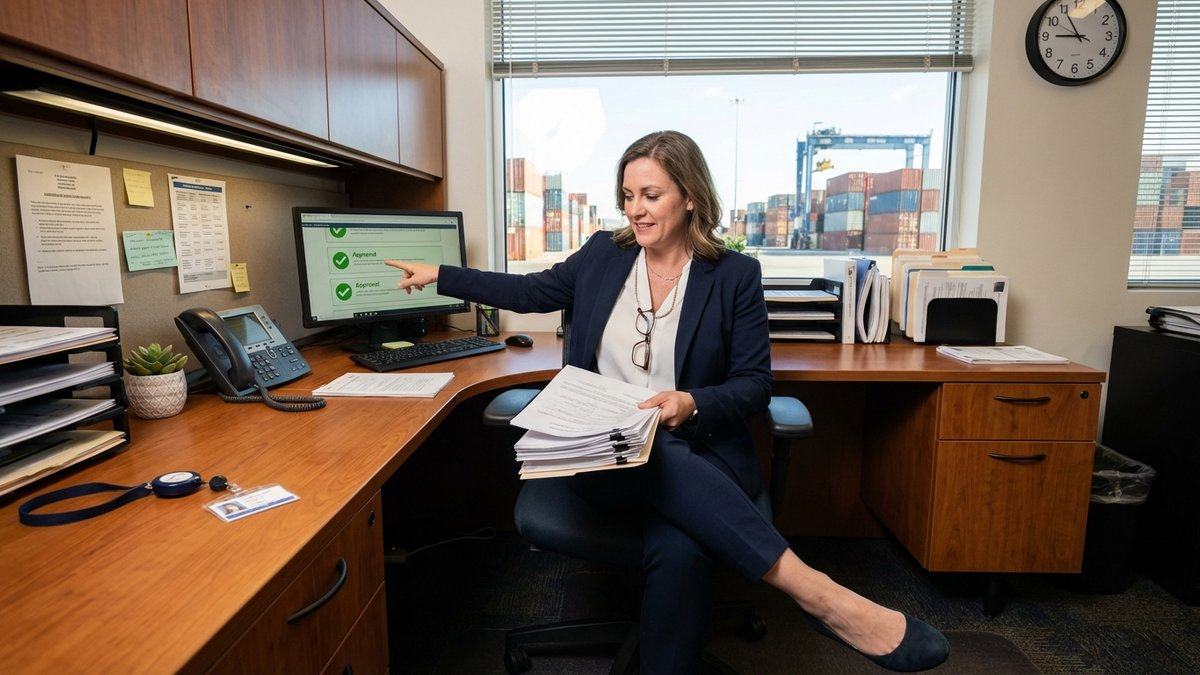
The containers have been discharged at the quay – in Burgas, Constanța or Piraeus. The maritime leg is over. Now begins the administrative phase that determines whether the cargo reaches the construction site on time or sits at the terminal while storage charges accumulate. Customs clearance is the point where documentation prepared months earlier meets the reality of a customs inspection.
What You Are Really Dealing With
Classification and Tariff Position
BESS batteries are classified under HS code 8507.60.00.90 – lithium-ion accumulators. This is the 10-digit code the customs broker should use when declaring the batteries. The source article states an EU import duty of 2.7% ad valorem on the CIF value, meaning cargo value plus insurance and freight.
Critical distinction: PCS (Power Conversion System) units have a different HS classification from the batteries. PCS units are transformer/power-conversion stations without a dangerous-goods class and must be declared separately. The customs broker should classify each component individually rather than declaring the entire BESS package under one tariff code.
EORI Registration – the Typical Scenario
EORI (Economic Operators Registration and Identification) is a mandatory identifier for customs operations in the EU. One EORI number is valid throughout the EU, but the key question is where fiscal customs clearance takes place.
A typical CEE scenario: cargo arrives at a discharge port such as Piraeus or Koper and is destined for Bulgaria. If fiscal clearance is performed at the discharge port, there are two options:
- EORI registration in the country of the discharge port, such as Greece or Slovenia.
- A fiscal representative – a local company that assumes joint responsibility for the customs obligations.
Under T1 customs transit, where the cargo passes through the discharge port without fiscal clearance, the EORI is required in the country of final clearance, such as Bulgaria or Romania.
Customs-Clearance Documentation
Customs documentation for BESS imports is a standard process. It is not exceptionally complex, but it requires precision. The required documents include:
| Document | Prepared by | Critical fields |
|---|---|---|
| Commercial Invoice | Manufacturer | Value, Incoterms, cargo description |
| Packing List | Manufacturer | Weight, number of units, serial numbers |
| Bill of Lading | Carrier or freight forwarder acting as contractual carrier | Weight (VGM), consignee, EORI |
| Certificate of Origin | Chamber of Commerce in the exporting country | Country of origin |
| CE Declaration of Conformity | Manufacturer or system integrator | Compliance with LVD, EMC and RoHS directives |
MSDS/SDS: this is a carrier requirement for loading, not normally a customs requirement. Import customs rarely requests an MSDS for BESS where the HS classification of the batteries is clear.
UN38.3 Test Summary: required for transport compliance and already available from the maritime stage. Customs authorities do not usually request it for clearance.
CE Marking – EU Battery Regulation (EU 2023/1542)
Since August 2024, CE marking for batteries has been mandatory under Regulation (EU) 2023/1542. For BESS systems above 2 kWh, the source article notes that from February 2027 a Digital Battery Passport with a QR code will be required, containing carbon-footprint and supply-chain traceability data.
As of April 2026, the critical requirements listed in the source are:
- CE marking with a Declaration of Conformity
- Labelling with capacity, composition and recycling symbol
- Carbon-footprint declaration for industrial batteries above 2 kWh, from February 2026
The Timeline
With perfect documentation, three working days is a realistic maximum for customs clearance.
When there are documentation problems, up to 10 working days is not unusual.
| Stage | Timing | What determines the range |
|---|---|---|
| Customs declaration filing | Day 1 | Availability of the final Bill of Lading copy and complete commercial documents |
| Document review | 1–2 days | Consistency between documents |
| Physical inspection, if required | +1–3 days | Random selection or discrepancies |
| Release | Day 3 | No outstanding issues |
Where procurement managers consistently underestimate:
- The time needed to receive the final Bill of Lading. The customs broker needs the final version, not a draft. The draft is only for the shipper to verify the data. If the carrier delays issuing the final document or the shipper sends it late, customs clearance cannot begin.
- The build-up of storage charges. Terminal storage starts accruing from discharge or shortly afterward, not from the moment customs clearance begins.
- Transit time does not include customs clearance. A 65-day transit time ends at the quay in Burgas, not at the construction site. Add 3–10 working days for customs plus inland transport.
The Documents
Who Prepares What
Prepared by the manufacturer:
- Commercial Invoice
- Packing List
- Certificate of Origin
- CE Declaration of Conformity
- UN38.3 Test Summary
- MSDS/SDS
Prepared by the carrier or freight forwarder acting as contractual carrier:
- Bill of Lading
Provided by the importer:
- EORI number
- Power of attorney for the customs broker
The Most Common Document Errors
Weight mismatch between the Packing List and the Bill of Lading. The manufacturer often enters weight in the Packing List based on standard or design specifications. The VGM declaration, based on actual weighing of the finished product after final internal securing, reflects the real weight and is used by the carrier for the Bill of Lading.
These mismatches occur because the Packing List is not updated after production changes, such as added securing components. The solution is to ensure the Packing List reflects the actually weighed cargo and matches the VGM data before the Bill of Lading is issued.
Mismatch in cargo description. The Commercial Invoice may say “BESS Container Unit”, the Bill of Lading “Lithium Battery System”, and the customs declaration “Energy Storage Equipment”. Customs may ask for clarification.
What Goes Wrong
1. CE Declaration Missing or Incomplete
What happens: the manufacturer provides a CE declaration, but it does not cover all applicable directives, such as LVD 2014/35/EU, EMC 2014/30/EU and RoHS 2011/65/EU, or it is issued for a different model.
Why: the system integrator assembled the BESS from components supplied by different manufacturers but did not issue its own CE declaration for the complete system.
Consequences: customs holds the release until a valid declaration is provided. This threatens commissioning windows and adds storage charges.
Prevention: require a CE declaration for the complete system, not just the cells, at least four weeks before loading. Check that it covers the exact model and serial numbers.
2. EORI Number Does Not Match the Documents
What happens: the EORI number in the customs declaration does not match the consignee shown in the Bill of Lading or Commercial Invoice.
Why: the project uses an SPV (Special Purpose Vehicle), while the documents were issued in the name of the EPC contractor or parent company.
Consequences: customs rejects the declaration. The documents must be corrected, adding 3–7 days.
Prevention: confirm the importer's EORI number and legal entity before the Bill of Lading is issued. All documents should show identical consignee details.

Every stamp represents a potential delay that could derail delivery schedules.
3. Weight Mismatch Beyond the Accepted Tolerance
What happens: the Packing List shows 42,500 kg and the Bill of Lading shows 43,200 kg. Customs requests an explanation.
Why: the Packing List is based on design specifications while the VGM is based on actual weighing after internal securing components are added.
Consequences: customs may require a physical inspection or corrected documentation, adding 2–5 working days.
Prevention: coordinate with the manufacturer to update the Packing List after VGM measurement. The source notes a typical tolerance of ±2%, although practice varies between customs administrations.
4. Customer Documentation Arrives Late
What happens: the cargo is discharged, but the customs broker still does not have a power of attorney.
Why: the importer's internal processes are slow. Legal has not signed the authorisation and Finance has not made funds available for duties and VAT.
Consequences: storage charges start accruing from the day of discharge. After more than seven days, costs can become significant.
Prevention: prepare the importer's documentation before the vessel arrives. The customs broker should have everything needed at least five working days before expected discharge.
5. Wrong HS Classification
What happens: the customs broker declares the entire shipment under a single HS code instead of distinguishing the batteries, 8507.60.00.90, from PCS units with a different classification.
Why: communication between procurement and the customs broker does not clearly describe the shipment's component structure.
Consequences: customs may reclassify the goods, leading to a different duty rate or additional documentation requirements and potentially adding 3–7 days.
Prevention: provide the customs broker with a detailed component list and proposed HS codes before loading. Confirm the classification with the broker.
What This Means for Your Project
- Confirm EORI registration eight weeks before expected arrival. If clearance is at a discharge port such as Piraeus or Koper, confirm whether you have the required local setup or will use a fiscal representative.
- Require a CE declaration for the complete system, not just the components. Check that it covers LVD, EMC and RoHS and is issued for the exact model.
- Coordinate an updated Packing List after VGM measurement. Weight documentation should be aligned before the Bill of Lading is issued.
- Prepare importer-side documentation before vessel arrival. Power of attorney, EORI confirmation and any financial security should be with the customs broker at least five working days in advance.
- Budget three working days for customs clearance with perfect documentation. With problems, allow up to 10 working days. The 65-day transit time ends at the quay, not the construction site.
What to Remember
- HS code 8507.60.00.90 for lithium-ion BESS batteries; the source article states a 2.7% ad valorem duty. PCS units are classified separately.
- One EORI number is valid throughout the EU, but the practical question is where fiscal clearance is performed. Clearance in another Member State may require local representation arrangements.
- Customs clearance is a standard process, but it depends on precise documentation: Commercial Invoice, Packing List, Bill of Lading, Certificate of Origin and CE declaration.
- Weight mismatch between the Packing List and Bill of Lading is a recurring issue. The Packing List may use design specifications while VGM reflects actual finished weight.
- Storage charges start after discharge, not after customs clearance. Every day of delay has a financial impact.
Frequently Asked Questions
Q: What HS code is used for BESS batteries imported into the EU?
A: The source uses 8507.60.00.90 for lithium-ion BESS batteries and states a 2.7% ad valorem duty on CIF value. PCS units have a different classification and should be declared separately.
Q: How long does customs clearance of a BESS shipment in Bulgaria take?
A: With perfect documentation, the source allows up to three working days. Where there are documentation problems such as weight mismatches, missing CE declarations or EORI discrepancies, it can take up to 10 working days.
Q: Do I need an EORI number in Greece if the cargo only passes through Piraeus?
A: It depends on the customs procedure. If fiscal clearance takes place in Piraeus, a Greek setup or fiscal representative may be required. Under T1 customs transit to Bulgaria, final clearance takes place in Bulgaria.
Q: Does customs require an MSDS for BESS batteries?
A: The source treats MSDS/SDS primarily as a carrier requirement at loading rather than a routine customs-clearance document.
Q: What happens when the Packing List and Bill of Lading show different weights?
A: Customs may request an explanation or physical inspection. The usual cause is that the Packing List uses design specifications while VGM reflects the actual finished weight. The solution is to update the Packing List before issuing the Bill of Lading.
Q: When do terminal storage charges start?
A: Storage charges start from discharge or shortly afterward, not from the point when customs clearance is completed.
Q: What CE requirements applied to BESS as of April 2026 in the source?
A: CE marking with a Declaration of Conformity covering the applicable directives, battery labelling requirements and the source's stated carbon-footprint declaration timeline for industrial batteries above 2 kWh.