

The Logistics of Goodbye: Reverse Logistics and End-of-Life Planning for BESS
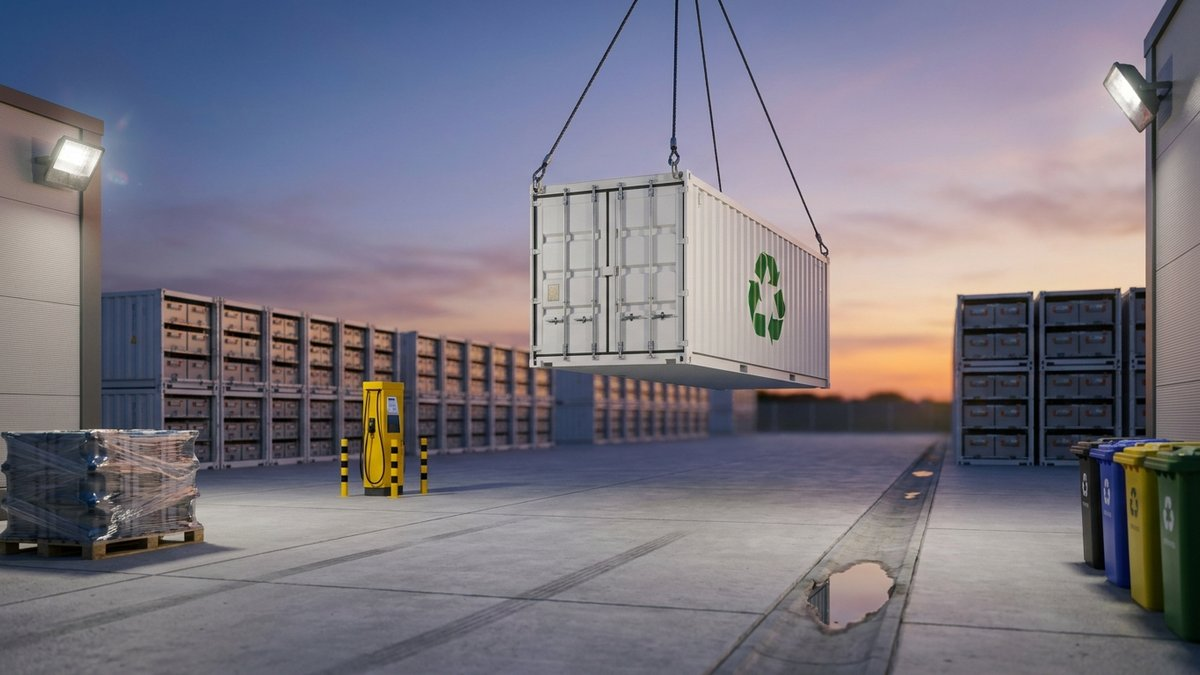
Series
Green Corridor: ESG and Sustainability in BESS Logistics
- Ep. 1 · Carbon Map
- Ep. 2 · Modal Shift
- Ep. 3 · Carbon Accounting
- Current episode: Ep. 4 · Reverse Logistics
The first BESS container that entered Bulgaria in 2019 is already seven years old. In another three to five years, it may need to move again. The question is: where does it go?
EU Battery Regulation 2023/1542 turns that question from a future concern into an operational obligation. Producer responsibility extends across the battery life cycle, including collection and recycling. For EPC companies building BESS parks in Central and Eastern Europe, reverse logistics should therefore be addressed at contract stage rather than treated as a problem for 15 years from now.
The Carbon / ESG Reality
Reverse logistics generates its own carbon footprint. End-of-life BESS containers still require specialist dangerous-goods handling, heavy-haul transport and often much longer road routes because large-scale lithium-ion recycling capacity in CEE remains limited.
The source notes that, as of June 2026, Bulgaria does not have a certified utility-scale lithium-ion battery recycling facility. It points to options in Germany, Belgium and Poland, meaning a BESS container from a project near Burgas may travel 1,500–2,000 km to a recycling facility.
The Numbers
EU Battery Regulation 2023/1542 introduces recycling-efficiency and material-recovery targets.
Recycling efficiency for lithium-ion batteries:
- 65% by 31 December 2025.
- 70% by 31 December 2030.
Material-recovery targets cited in the source:
- By the end of 2027: 90% for cobalt, copper, nickel and lead; 50% for lithium.
- By the end of 2031: 95% for cobalt, copper, nickel and lead; 80% for lithium.
For LFP batteries, which dominate many BESS installations, increasing lithium recovery from 50% to 80% is a technical and commercial challenge.
Reverse-transport footprint:
Using the source's road-transport assumptions, moving one 43-tonne BESS container roughly 1,800 km from Burgas to a recycling facility in Germany produces about 1.2–1.5 tonnes CO₂e. In the article's reporting model, this belongs in Scope 3 Category 5, Waste Generated in Operations.
The Regulatory Framework
EU Battery Regulation 2023/1542 is the central framework. The source highlights:
- Supply-chain due-diligence obligations.
- Waste-battery collection, treatment and recycling rules.
- Collection mechanisms for industrial and EV batteries.
- Recycling-efficiency and material-recovery targets.
Extended Producer Responsibility:
The party legally treated as the “producer” needs to meet EPR obligations and register in the relevant producer-responsibility system in the markets where batteries are placed on the market. For BESS projects, the EPC contract should make that responsibility explicit.
Transport classification in reverse logistics:
End-of-life BESS batteries remain dangerous goods:
- UN3536 for integrated BESS cargo transport units in the source's classification.
- ADR Class 9 for road transport.
- IMDG Class 9 if moved by sea.
Damaged or defective batteries require special handling and cannot simply follow ordinary reverse-logistics procedures. The source points to special provisions for damaged lithium batteries under ADR.
The Practical Approach
Plan Reverse Logistics in the EPC Contract
1. Identify the responsible party.
Clarify who is the “producer” for EPR purposes. If the EPC contractor imports the BESS equipment, it may inherit obligations it did not budget for unless responsibility is clearly allocated.
2. Register in the appropriate producer-responsibility scheme.
Registration follows the market where batteries are placed on the market and the chosen customs/import structure.
3. Budget for decommissioning.
The source uses an industry planning assumption of around 5–6% of project CAPEX for future deinstallation and recycling costs.
4. Build life-cycle documentation from day one.
The Digital Battery Passport requires data that cannot realistically be reconstructed years later, including:
- Carbon footprint.
- Origin of raw materials.
- State of Health.
- Usage history.
Deinstallation Logistics
Stage 1: De-energise
- Isolate the AC grid connection.
- Discharge the DC system to a safe transport level.
- Disable fire-suppression systems as required by the procedure.
- Apply lockout-tagout.
Stage 2: Disconnect
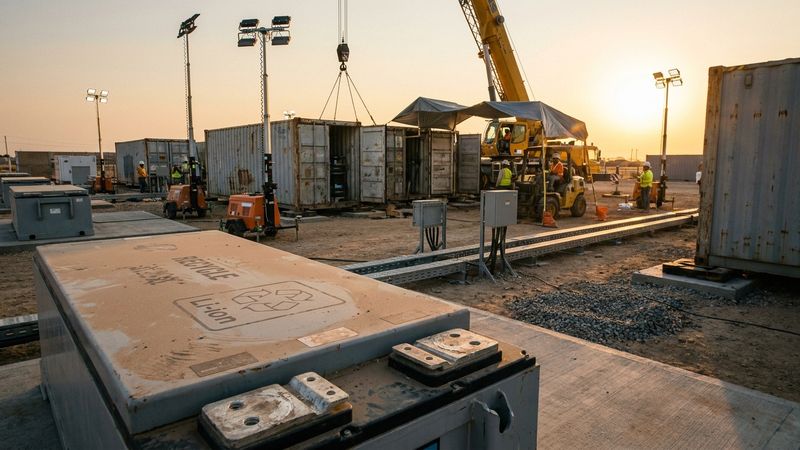
The recycling symbol that will shape the economics of Europe's energy transition.
- Physically disconnect cables and conduits.
- Dismantle auxiliary structures.
Stage 3: Dismantle and load
- Use appropriate lifting equipment such as cranes or telehandlers.
- Load onto specialist heavy-haul transport.
Stage 4: Transport to the recycling facility
- Prepare ADR transport documentation and battery compliance documentation.
- Arrange oversized-load permits.
- Ensure Class 9 placarding is compliant.
Second Life vs Recycling
Before recycling, some batteries can be repurposed for lower-demand applications. The source refers to EN 18061:2025 for safe repurposing of EV batteries into stationary storage.
For BESS batteries that have already served in stationary storage, second-life options are more limited. The likely end-state is direct recycling once usable capacity and performance fall below the project's threshold.
The Greenwashing Trap
“100% recyclable batteries” may be technically true but operationally misleading. Recyclable does not mean actually recycled if collection and treatment infrastructure is missing.
“Closed-loop materials” should not be claimed more broadly than the actual recycled-content and recovery system supports.
“Carbon-neutral reverse logistics” does not remove actual transport emissions; offsets should be reported separately from gross Scope 3 emissions.
What This Means for Your Project
- Put EPR obligations into the EPC contract and define who bears producer-responsibility registration.
- Budget explicitly for deinstallation, transport and recycling.
- Start collecting battery-passport data from day one.
- Identify likely recycling partners early because European capacity is constrained.
- Plan the reverse-logistics route with the same care as the original delivery: dangerous-goods rules, heavy-haul permits and transit countries still matter.
What to Remember
- Battery life-cycle responsibility turns reverse logistics into a contractual obligation, not a distant future problem.
- CEE recycling capacity is limited, so end-of-life BESS units may need long cross-border movements.
- Battery-passport data must be collected during operation, not reconstructed at the end.
- Material-recovery targets become progressively stricter toward 2031.
- Reverse logistics creates its own Scope 3 footprint and needs to be included in ESG accounting.
Frequently Asked Questions
Q: Who is responsible for recycling BESS batteries under EU Battery Regulation 2023/1542?
A: The legal “producer”, typically the entity placing the battery on the EU market. If a non-EU integrator is involved, the importer may assume obligations. The EPC contract should clarify this.
Q: What recycling-efficiency targets apply?
A: The source cites 65% by the end of 2025 and 70% by the end of 2030 for lithium-ion batteries, alongside progressively higher material-recovery targets.
Q: Are there utility-scale BESS recycling facilities in Bulgaria?
A: The source states that, as of June 2026, there was no certified utility-scale lithium-ion recycling facility in Bulgaria and points to facilities in Germany, Belgium and Poland.
Q: What decommissioning budget should be assumed?
A: The source uses an industry planning estimate of roughly 5–6% of project CAPEX.
Q: When does the Digital Battery Passport become mandatory?
A: The source highlights 18 February 2027 for industrial batteries above 2 kWh, with data including carbon footprint, raw-material origin, State of Health and usage history.
Q: How are end-of-life BESS units classified for transport?
A: They remain dangerous goods under the relevant ADR/IMDG rules, with additional requirements for damaged or defective batteries.
Q: What Scope 3 emissions does reverse logistics create?
A: The article treats them within waste-related Scope 3 accounting and gives an example of roughly 1.2–1.5 tonnes CO₂e for a 43-tonne container moved about 1,800 km by road.