

Carbon Footprint Compliance for BESS Logistics: What the EU Battery Regulation Actually Requires
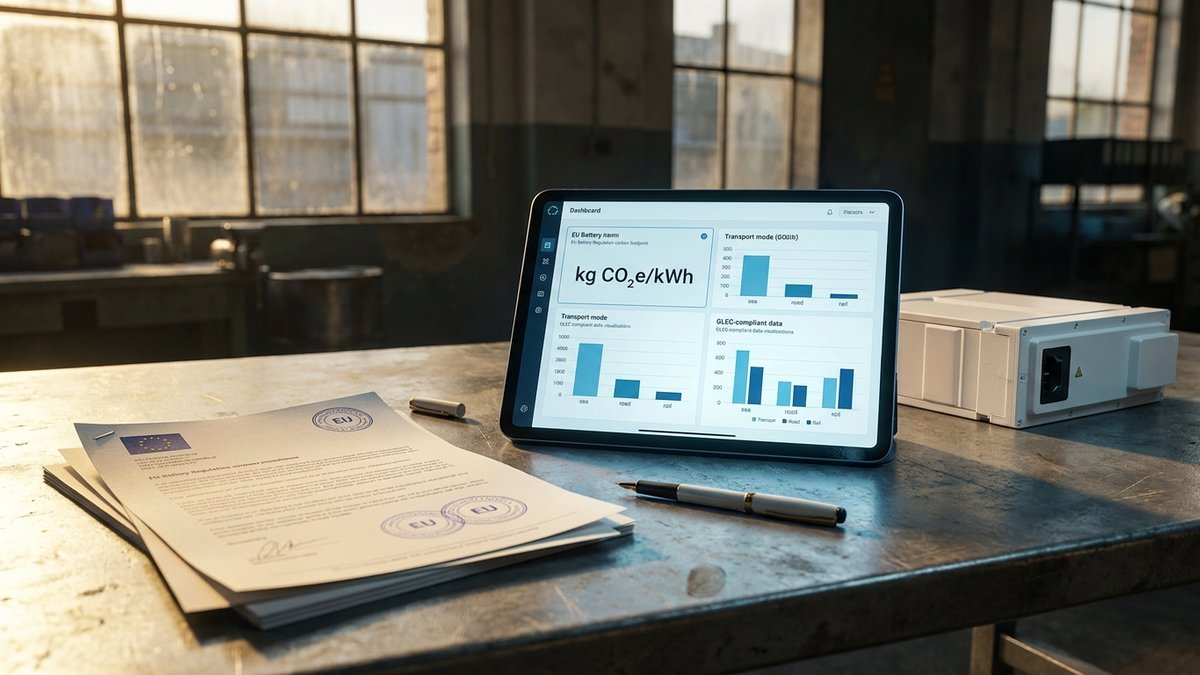
Series
Green Corridor: ESG and Sustainability in BESS Logistics
- Ep. 1 · Carbon Map
- Ep. 2 · Modal Shift
- Current episode: Ep. 3 · Carbon Accounting
- Ep. 4 · Reverse Logistics
Carbon Accounting for BESS Logistics: What Scope 3 Actually Requires
When a sustainability team prepares the ESG report for a BESS project, transport emissions are rarely the first concern. The batteries will store clean energy, balance the grid and reduce dependence on fossil generation. Logistics can look like a technical detail.
That detail carries weight. A 230 MWh BESS project may require around 46 containers at roughly 43 tonnes each, transported from China to a construction site in Central and Eastern Europe. Sea freight, transshipment in Piraeus or Istanbul, discharge in Burgas or Constanța and inland haulage all generate emissions that belong in the corporate Scope 3 inventory. From September 2026, the source also highlights the EU rules tightening generic environmental claims without demonstrable methodology.
The Carbon / ESG Reality
Transport emissions are not negligible. A China-to-Burgas route around the Cape of Good Hope means roughly 55–70 days of transit and close to 20,000 km of maritime movement. Inland transport adds another 100–500 km by heavy truck.
For an EPC company reporting under the GHG Protocol Corporate Standard, the article treats these emissions as Scope 3 Category 4, Upstream Transportation and Distribution. For projects with ESG conditions attached to financing, the practical question is not whether to measure logistics emissions, but how to calculate them in a way that can withstand audit.
The Numbers
GLEC Framework v3.2, used as the article's practical implementation guide for ISO 14083:2023, provides emission factors by transport mode.
Sea transport, container vessel:
- 7–19 g CO₂e/tonne-km well-to-wheel in the source range.
- 46 containers × 43 tonnes × 20,000 km gives roughly 277–530 tonnes CO₂e for the sea leg in the source example.
Road transport, heavy truck above 34 tonnes:
- 50–80 g CO₂e/tonne-km WTW depending on load and fuel.
- 46 containers × 43 tonnes × 300 km gives roughly 30–50 tonnes CO₂e for the inland leg.
Electrified rail:
- 5–15 g CO₂e/tonne-km WTW depending on the electricity mix.
- Potential reduction of roughly 70–90% compared with road transport.
Total for a typical 230 MWh project in the article: around 300–600 tonnes CO₂e for transport from factory to site.
The source puts that into context against the much larger operational emissions savings a BESS system can enable over its lifetime. That does not make logistics emissions irrelevant to reporting; it simply keeps the scale in perspective.
The Regulatory Framework
Three layers shape the reporting approach:
ISO 14083:2023 provides the international methodology for quantifying greenhouse-gas emissions arising from transport-chain operations. GLEC Framework v3.2 is used here as the industry implementation guide.
GHG Protocol Scope 3 defines Category 4 for upstream transportation and distribution. For an EPC business moving imported BESS equipment, logistics is material to the project footprint.
EU Battery Regulation 2023/1542 introduces carbon-footprint requirements for industrial batteries. The source treats transport as part of the broader life-cycle accounting that needs to be documented alongside product-level battery data.
Directive (EU) 2024/825, highlighted in the article for its 2026 application, restricts generic environmental claims and climate-neutrality claims that cannot be substantiated appropriately.
The Practical Approach
Step 1: Define the Boundary
Scope 3 Category 4 can include:
- Transport of purchased products from suppliers to the reporting company's operations.
- Third-party logistics services such as freight forwarding and carriage.
- Storage in warehouses and terminals.
For a BESS project, map the full chain: sea transport from the manufacturer's origin, hub transshipment, feeder connection to the Black Sea port, terminal handling and inland transport to site.
Step 2: Collect the Data
GLEC supports several calculation approaches:
- Distance-based: distance × weight × emission factor by mode.
- Fuel-based: actual fuel-consumption data from the carrier.
- Spend-based: financial spend multiplied by average emissions per currency unit, usually the least precise.
For BESS, the distance-based method is often the most practical. Capture:
- Port of loading.
- Port of discharge.
- Route, including direct Suez or COGH with transshipment.
- Number of containers and gross weight.
- Inland distance to the site.
Step 3: Calculate
The source uses representative WTW factors of roughly 12 g CO₂e/tonne-km for sea container transport and 62 g CO₂e/tonne-km for a heavy diesel truck, with actual values varying by vessel, load, fuel and route.
Step 4: Document
ISO 14083-style reporting should record:
- Methodology and framework version.
- Emission-factor sources.
- Assumptions such as load factor.
- Calculation boundaries.
- Calculation date and responsible person.
The Greenwashing Trap
The source flags generic claims such as “carbon-neutral delivery” without a transparent calculation method and credible evidence. Product-level neutrality claims based only on purchased offsets are particularly sensitive under the EU's tighter green-claims framework.
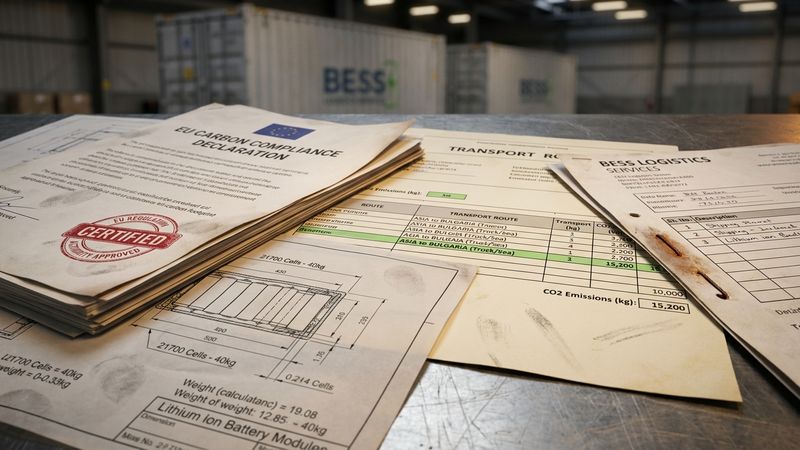
Compliance turns from a regulatory burden into a competitive advantage through precise documentation.
“Green logistics” as a broad statement is not enough. A forwarder should be able to quantify what is greener: percentage reduction against a baseline, use of alternative fuels, modal shift or another documented intervention.
Self-created sustainability labels also need credible third-party or public-standard backing.
What This Means for Your Project
1. Ask the forwarder for emissions data before contract signature.
Ask which methodology they use, whether they can provide GLEC/ISO 14083-compatible values and whether they report WTW by transport leg.
2. Include transport emissions from the start of ESG reporting.
Do not wait until project close. Set the Scope 3 boundary and data requirements while the logistics strategy is still being designed.
3. Document route and modal choice.
A longer COGH route and a direct Suez route do not have the same emissions. If a longer route is chosen for reliability, record the reason.
4. Assess modal shift.
Rail on the inland leg can cut emissions materially where suitable infrastructure exists.
5. Avoid generic environmental claims.
Use quantified statements such as: “Transport emissions for this project were calculated at X tonnes CO₂e using GLEC Framework v3.2,” rather than unsupported “green” or “carbon-neutral” language.
What to Remember
- The source's typical 230 MWh BESS case produces around 300–600 tonnes CO₂e from transport and belongs in Scope 3 logistics reporting.
- GLEC Framework v3.2 and ISO 14083:2023 are the reference methodologies used in the article; use WTW rather than only TTW where full accounting is required.
- EU rules are tightening around generic environmental claims and product-neutrality messaging.
- Battery product-footprint data and project logistics data both need robust documentation.
- Modal shift from road to rail can materially reduce the inland transport footprint.
Frequently Asked Questions
Q: Which transport emissions belong in Scope 3 Category 4 for a BESS project?
A: Upstream transport of purchased equipment, including sea freight, hub transshipment, feeder services and inland transport, plus relevant third-party storage and logistics services within the company's reporting boundary.
Q: What is the difference between WTW and TTW emission factors?
A: TTW covers direct fuel combustion. WTW adds the upstream production and distribution of fuel, giving a more complete transport footprint.
Q: How do I calculate emissions if I do not have carrier fuel data?
A: Use the distance-based method: distance × cargo weight × an appropriate emission factor by transport mode, with the factor source documented.
Q: How much can rail reduce emissions versus road?
A: The source uses a 70–90% reduction range for electrified rail versus heavy diesel trucking, depending on the electricity mix.
Q: What data should I request from the forwarder?
A: Calculation methodology and version, WTW factors by leg, route distances, transport modes and the gross cargo weight used in the calculation.
Next episode
BESS Reverse Logistics: When the Batteries Start Moving Back