

Class 9 Decoded: What Every BESS Procurement Team Must Know About Dangerous Goods Classification
Series
IMDG/ADR Decoded: The Regulatory Guide to BESS Transport
- Current episode: Ep. 1 · Class 9 - Dangerous Goods Classification
- Ep. 2 · The Documents - The Complete Transport Package
- Ep. 3 · IMDG 42-24 / ADR 2025 - What Changed
- Ep. 4 · Case Study - When Documents Don't Match
Three UN Numbers, One Expensive Mistake
Class 9, Miscellaneous Dangerous Goods, is the category into which lithium-ion batteries fall under international dangerous-goods transport rules. It is not the “most dangerous” class; it covers substances and articles that present a transport hazard but do not fit into the other eight classes.
For sea transport, the applicable framework is the IMDG Code, Amendment 42-24, mandatory from 1 January 2026. For road transport in Europe, ADR 2025 applies. The two systems are harmonised through the UN Model Regulations but differ in their practical application.
Authoritative texts are available through IMO for the IMDG Code and UNECE for ADR.
The Classification That Determines Everything
Battery Energy Storage Systems are not simply “large batteries”. They are integrated systems combining battery modules, a Battery Management System, thermal management, fire protection and often their own container. That complexity creates specific classification challenges.
The three UN numbers to know are:
- UN3480 – Lithium-ion batteries, standalone.
- UN3481 – Lithium-ion batteries contained in or packed with equipment.
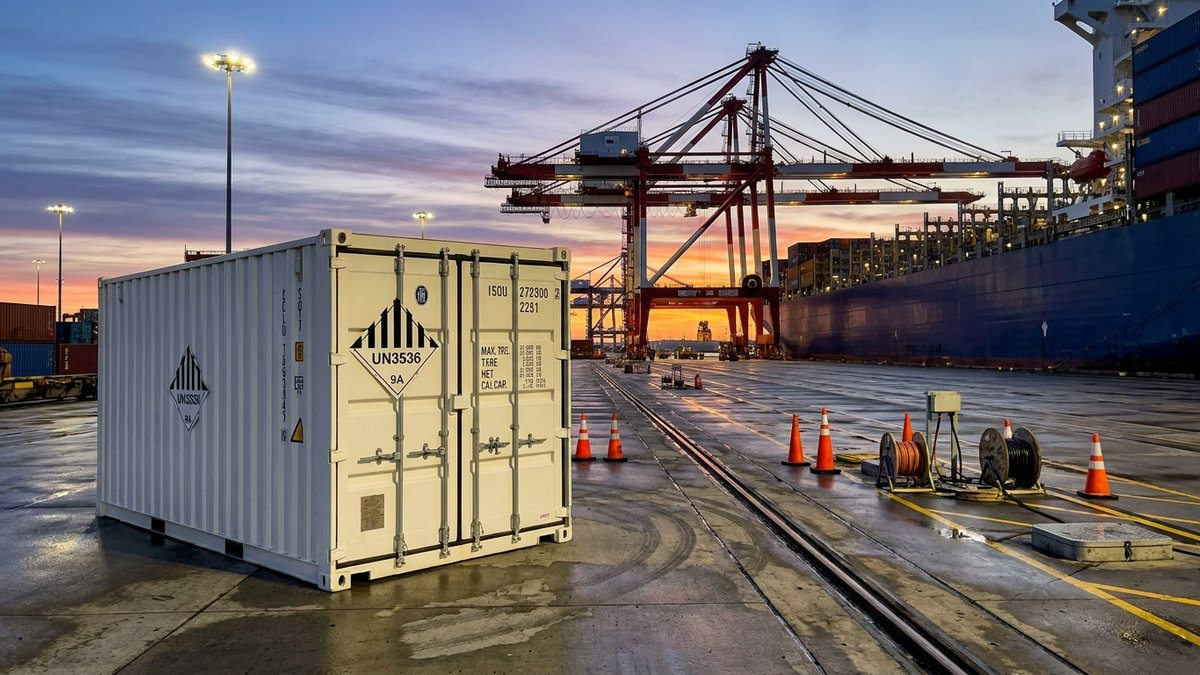
- UN3536 – Lithium batteries installed in a cargo transport unit.
The critical distinction: where the battery system is a self-contained unit designed to supply energy to external systems – for example storing and delivering energy to a grid – the source classifies it as UN3536. If the battery only powers the equipment in which it is installed, UN3481 applies.
For utility-scale containerised BESS, UN3536 is the relevant classification in the source. That choice drives documentation, placarding and stowage requirements.
UN3536, UN3480, UN3481: the Differences
Classification Code and Labelling
The source describes UN3536 under IMDG Code 42-24 / ADR 2025 as:
- Class: 9
- Classification code: M4, lithium batteries
- Packing group: not applicable
- Label: Class 9A, the battery-specific label
The Class 9A label includes a battery symbol for rapid identification of lithium or sodium battery risks across the transport chain.
Stowage Category
A key change highlighted in IMDG 42-24 is the move of UN3536 from Stowage Category A, on or below deck, to Category D, on deck only.
That means the source treats BESS containers as no longer permitted in the ship's hold. Additional stowage codes include:
- SW1 – protected from sources of heat
- SW2 – away from living quarters
The change reflects concern about thermal runaway and the need for ventilation and access in the event of an incident.
State of Charge
The source applies a ≤30% State of Charge transport condition to lithium-ion battery shipments, including BESS. It also notes evolving IATA requirements for air transport of lithium batteries.
UN38.3 Testing – a Mandatory Condition
Before transport, lithium batteries must successfully complete the tests in the UN Manual of Tests and Criteria, Part III, Section 38.3:
- T1 – Altitude simulation
- T2 – Thermal test
- T3 – Vibration
- T4 – Shock
- T5 – External short circuit
- T6 – Impact/crush
- T7 – Overcharge
- T8 – Forced discharge
Passing means no disassembly, fire or leakage of toxic/corrosive substances under the test criteria.
Special Provisions
For UN3536, the source highlights Special Provision 389, requiring:
- Batteries to be securely attached to the internal structure of the cargo transport unit.
- Protection against overcharge and over-discharge.
- Appropriate fire-protection and cooling systems.
- No unrelated dangerous goods in the same cargo transport unit.
UN3480 and UN3481 are subject to different special provisions.
Placarding
The source requires Class 9 placards and UN-number markings on all four sides of the container – left, right, front and rear – with placards at least 25 × 25 cm.
For UN3536, individual modules inside the container do not require separate external placards; the marking is applied at cargo-transport-unit level.
Tunnel Restrictions under ADR
The source gives UN3536 tunnel code E, restricting passage through Category E tunnels while allowing Categories A–D.
The Full Documentation Package
Required Sea-Transport Documentation
| Document | Prepared by | Format | Language |
|---|---|---|---|
| Dangerous Goods Declaration | Shipper | Standard IMO format | English |
| UN38.3 Test Summary | Manufacturer | PDF, available on request | English |
| MSDS/SDS | Manufacturer | Standard 16-section format | English + local language where needed |
| Bill of Lading | Carrier or contractual freight forwarder | Standard format | English |
| Packing List | Manufacturer | Free format | English |
| Commercial Invoice | Manufacturer | Free format | English |
Required Road-Transport Documentation
| Document | Prepared by | Contents |
|---|---|---|
| ADR transport document | Road carrier | UN number, PSN, class, tunnel code, packages and weight |
| Instructions in Writing | Shipper | Emergency measures in required languages |
| UN38.3 Test Summary | Manufacturer | Available on request |
Common Documentation Errors
- Wrong classification: declaring a BESS container as UN3481 instead of UN3536.
- Missing UN38.3 Test Summary, which can lead to refusal to load.
- Weight mismatch between Packing List and VGM.
- Outdated MSDS/SDS rejected by the carrier.
- Wrong external label or placarding.
What Inspectors Check
Bulgaria
Road inspections focus on the ADR transport document, correct vehicle/container marking, driver ADR qualification and heavy-load permits. The source describes customs clearance in Burgas and Varna as standard when the commercial documents are correct and cites a 2.7% duty for HS 8507.60.00.90.
Romania
The source notes particular attention in Constanța to the consistency between declared and actual classification and the availability of UN38.3 documentation.
Poland
Gdańsk and Gdynia handle significant BESS volumes for Central European projects, with detailed ADR-document checks on the road leg.
Common CEE Observations
- Weight-document mismatches between Packing List and Bill of Lading are a common source of delay.
- Battery-specific labelling/placarding requirements are not always consistently understood across the chain.
- The move from Stowage Category A to D for UN3536 requires operational adaptation by carriers.
Four Ways It Breaks
Scenario 1: Wrong UN Classification
Violation: a BESS container is declared as UN3481 instead of UN3536.

When one cell overheats, physics takes control. Visualising thermal runaway.
What happened: the ocean carrier refused the cargo.
Consequences: five working days to issue new documentation, a missed sailing and a total delay of 15 days.
Scenario 2: Missing UN38.3 Test Summary
Violation: the manufacturer confirmed the batteries passed UN38.3 but could not provide the Test Summary when requested.
What happened: the carrier refused loading in Shanghai. The manufacturer needed five working days to prepare and send the document.
Consequences: the sailing was missed and the next available sailing was two weeks later.
Scenario 3: Incorrect Placarding
Violation: Class 9 placards were fitted on only two sides rather than all four.
What happened: the carrier refused the cargo until the containers were correctly marked.
Consequences: one working day of delay to source and apply additional placards.
Scenario 4: SoC above 30%
Violation: a BESS container reached the port with documented SoC of 45% rather than the source's ≤30% transport requirement.
What happened: the carrier refused the cargo. Discharging the batteries at the port was not practical.
Consequences: the cargo returned to the manufacturer for discharge, creating a 3–4 week delay depending on return logistics.
In Brief
- SP 389 requires UN3536 BESS units to be securely attached within the cargo transport unit and equipped with protective systems.
- IMDG 42-24 moves UN3536 to on-deck-only Stowage Category D in the source.
- UN38.3 requires eight battery transport tests and a Test Summary available on request.
- The source calls for battery-specific Class 9A placarding on four sides of UN3536 containers.
- The source treats ≤30% SoC as a critical sea-transport acceptance condition.
Frequently Asked Questions
Q: What is the difference between UN3481 and UN3536 for BESS?
A: UN3481 applies where a battery powers the equipment in which it is installed. The source uses UN3536 where the battery system supplies external loads, as with grid-scale BESS.
Q: Why was UN3536 moved to on-deck-only stowage?
A: The source links the change to thermal-runaway risk, ventilation and the need to avoid gas accumulation below deck.
Q: What if the UN38.3 Test Summary is unavailable?
A: The carrier may refuse the cargo until the summary is produced, potentially causing a missed sailing.
Q: What State of Charge does the source require for sea transport?
A: ≤30% of nominal capacity.
Q: How many Class 9A placards are required?
A: The source specifies four, one on each side of the container, at least 25 × 25 cm.
Q: Does SP 389 apply to UN3481?
A: No. The source treats SP 389 as specific to UN3536.
Q: What tunnel restrictions apply under ADR?
A: The source gives tunnel code E for UN3536 and says Category E tunnels are prohibited.
Next episode
The Documents: The Complete Package for Sea and Road Transport of BESS
Dangerous Goods Declaration, ADR transport document, markings and UN38.3 Test Summary – the full IMDG/ADR documentation checklist from factory to site.