

IMDG 42-24 and ADR 2025: What Changed for BESS Transport on 1 January 2026
Series
IMDG/ADR Decoded: The Regulatory Guide to BESS Transport
- Ep. 1 · Class 9 - Dangerous Goods Classification
- Ep. 2 · The Documents - The Complete Transport Package
- Current episode: Ep. 3 · IMDG 42-24 / ADR 2025 - What Changed
- Ep. 4 · Case Study - When Documents Don't Match
1 January 2026: The Line in the Sand
IMDG Code Amendment 42-24 became mandatory on 1 January 2026, replacing Amendment 41-22 after a 12-month transitional period. The amendment was adopted by IMO Resolution MSC.556(108) in May 2024. For road transport, ADR 2025 entered into force on the same date, harmonised with the 23rd edition of the UN Model Regulations.
Official texts:
IMDG Code Amendment 42-24: available from IMO Publishing (IA200E).
ADR 2025: published by UNECE.
In short, the amendments restructured how lithium batteries, including those used in BESS, are classified, stowed and documented. The changes reflect experience accumulated from maritime incidents and the rapid growth of battery shipments since 2020.
Stowage Category D: the Change That Affects Everything
The most significant change highlighted for BESS transport is the move of UN3536 from Stowage Category A, on or below deck, to Stowage Category D, on deck only. In the source, every BESS container must therefore be stowed on open deck. A carrier accepting such cargo below deck would be non-compliant with the stated IMDG requirements.
The source also highlights SW1, away from sources of heat, and SW2, away from living quarters. On smaller container ships, this reduces the number of usable slots, which can mean earlier booking and potentially higher rates in peak periods.
Three Scenarios from the First Quarter
Scenario 1: Wrong UN Classification
Violation: the shipper declares a BESS container as UN3481, batteries in equipment, rather than UN3536, batteries installed in a cargo transport unit.
What happened: the carrier rejected the booking during document review. While the correct DGD was prepared, the cargo missed the documentation cut-off for the intended sailing and remained at the terminal for another seven days.
Consequences: missed sailing, another 7–8 days in the schedule and storage charges at the Shanghai terminal.
Scenario 2: Missing Placards on All Four Sides
Violation: a BESS container arrives at the Shanghai load port with Class 9 placards on only the left and right sides, with no placards on the front and rear.
What happened: the carrier recorded a non-conformity. The containers were held at the terminal until the shipper arranged compliant markings on all sides.
Consequences: additional export storage days. The cargo missed the intended sailing and had to move on the next vessel at a higher ocean-freight cost.
Scenario 3: Weight-Document Mismatch
Violation: the Packing List states 42,800 kg while the VGM declaration states 43,450 kg.
What happened: customs in Constanța requested an explanation. The manufacturer confirmed that the Packing List used design specifications while VGM reflected actual final weight after production and internal securing.
Consequences: two working days of delay for documentary clarification. The solution is to make the Packing List reflect actual weighed cargo and align it with VGM before the Bill of Lading is issued.
BESS containers in the open. The new regulation brings dangerous goods into the light.
The New Baseline
IMDG 42-24, Table A, UN3536: the source states that the stowage category changed from A to D, meaning BESS containers are carried on deck only and are prohibited on passenger ships.
IMDG 42-24, Section 7.1.2, SW1 and SW2: BESS containers should be protected from heat sources and positioned away from living quarters.
ADR 2025, Section 2.2.9.1.7.2: sodium-ion batteries, UN3551 and UN3552, have their own classifications and are subject to corresponding special provisions.
ADR 2025, Section 5.4.1.1.21: transport documentation should include all required data referenced across ADR, not only the standard fields.
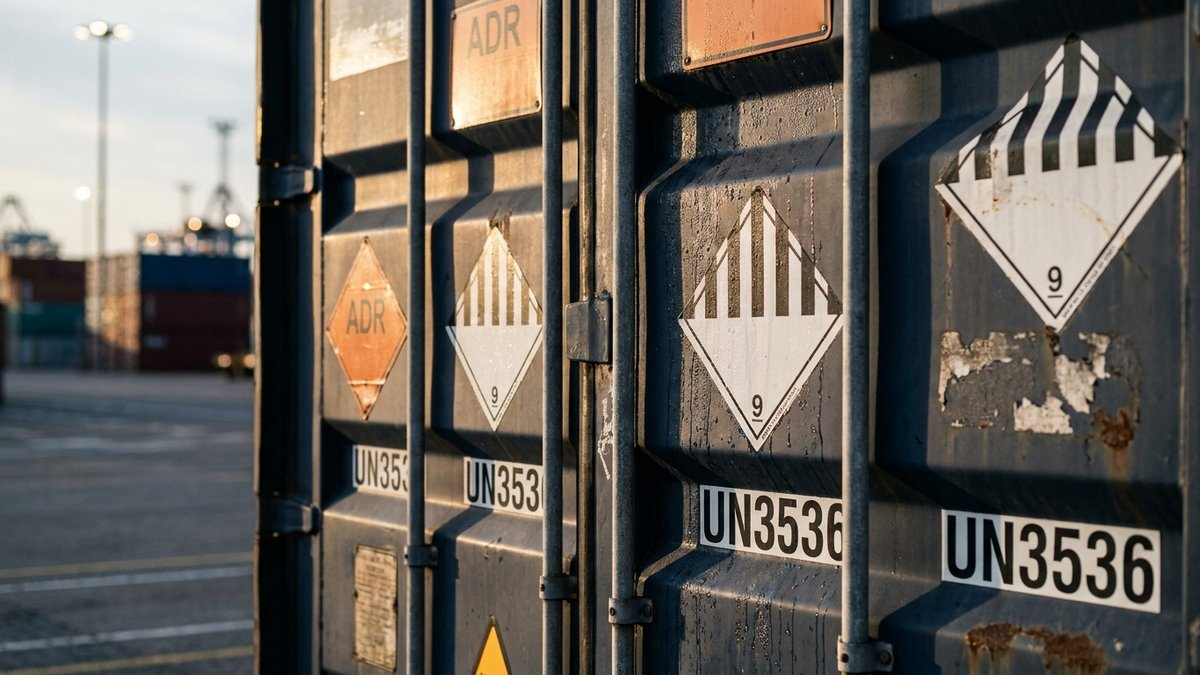
Practical requirement in the source: Class 9 placards on FOUR sides of the container – left, right, front and rear – not two.
Frequently Asked Questions
Q: What is the difference between UN3480, UN3481 and UN3536 for BESS?
A: UN3480 is used for standalone lithium-ion batteries, UN3481 for batteries contained in or packed with equipment, and UN3536 for batteries installed in a cargo transport unit. Containerised BESS units whose container is the product enclosure are treated as UN3536 in the source.
Q: When did IMDG Code Amendment 42-24 become mandatory?
A: 1 January 2026. The voluntary transitional period ran from 1 January through 31 December 2025.
Q: Can BESS containers be carried below deck after 1 January 2026?
A: Not under the source's stated UN3536 Category D interpretation; it treats the units as on-deck-only.
Q: What is the State of Charge requirement for BESS sea transport?
A: The source notes that IMDG does not impose a simple explicit UN3536 SoC limit in the same way in every context, but states that industry practice and leading carriers use ≤30% as an acceptance condition.
Q: How many Class 9 placards are required on a BESS container?
A: Four – left, right, front and rear – according to the source's transport-marking checklist.
Q: What new UN numbers does IMDG 42-24 introduce for batteries and battery-powered vehicles?
A: The source lists UN3551 and UN3552 for sodium-ion batteries and UN3556, UN3557 and UN3558 for vehicles powered by lithium-ion, lithium-metal and sodium-ion batteries respectively.
Q: What HS code does the source use for BESS batteries imported into CEE?
A: 8507.60.00.90 for lithium-ion BESS batteries. PCS equipment is classified separately.
Next episode
When Documents Don't Match: Anatomy of a Detained BESS Shipment
A BESS shipment from Asia to CEE, the documentation gaps that stopped it, and how mismatches between transport documents can consume days or weeks.