

INCOTERMS 2020 Delivery Terms

What are Incoterms and what do they regulate?
INCOTERMS, short for International Commercial Terms, are issued by the International Chamber of Commerce (ICC) in Paris and regulate:
- The allocation of transport responsibilities between the seller and the buyer
- The allocation of risk for cargo damage or loss between the seller and the buyer
- The allocation of responsibilities for loading and unloading the goods to and from the transport vehicle
- The allocation of responsibilities for customs clearance
- The allocation of responsibilities for cargo insurance during transport
What do INCOTERMS not regulate?
Although INCOTERMS regulate many aspects of international trade, they do not cover several important areas. These include transfer of ownership, payment terms, applicable law, exclusions and limitations of liability, and penalties for non-performance.
It is also important to know that:
- INCOTERMS are not mandatory law
- Their application must be agreed between the parties
- Because they provide a precise commercial framework, they are commonly incorporated into international trade contracts
- INCOTERMS 2020 have been in force since 1 January 2020
What are the different delivery terms?
The delivery terms can be grouped according to where risk and costs transfer from the seller to the buyer. The following are the delivery terms under Incoterms 2020:
INCOTERMS 2020
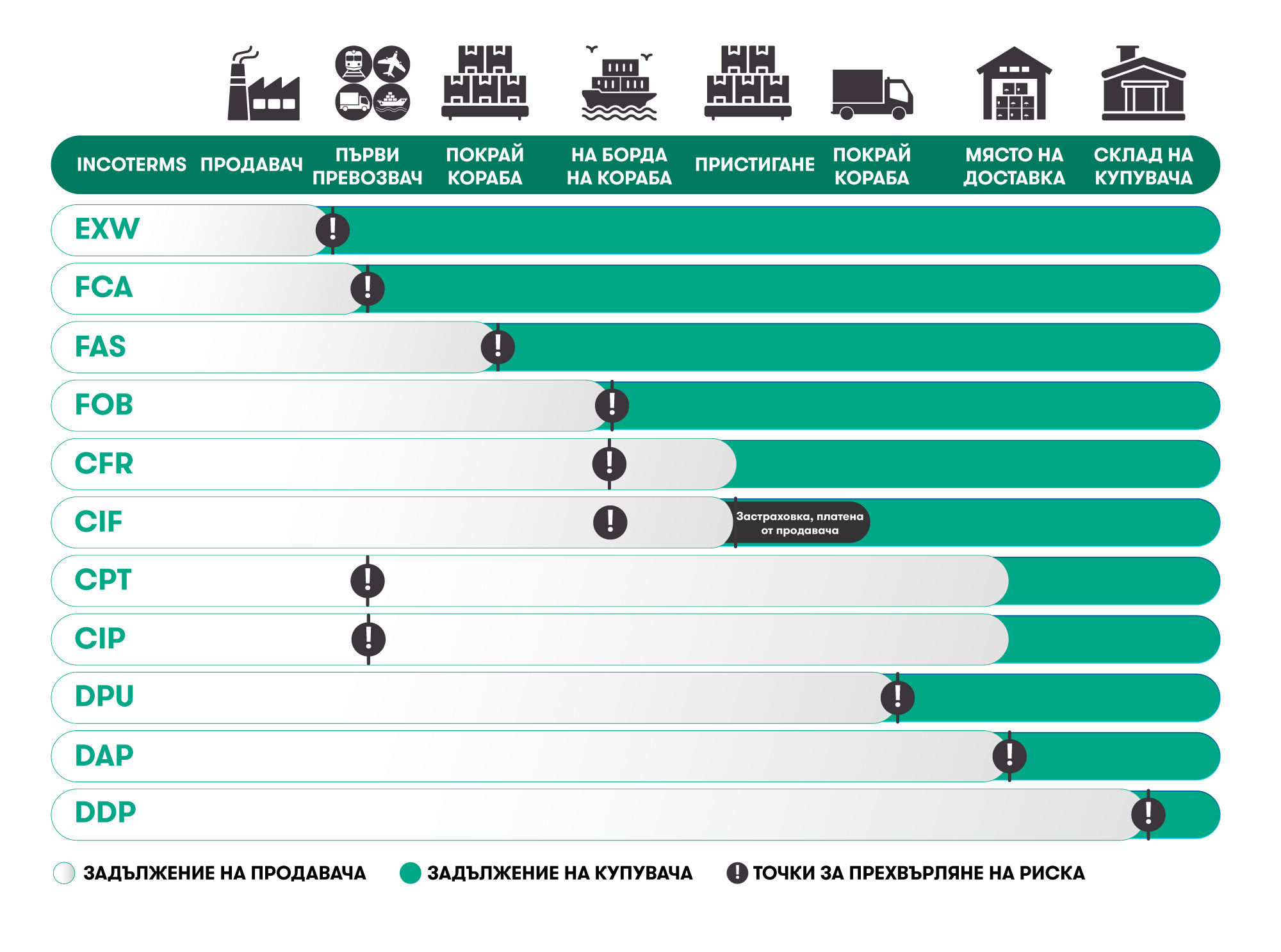
- EXW / Ex Works – the seller's obligations are minimal and the buyer's are maximal. The seller makes the goods available at its premises, while the buyer is responsible for loading on the agreed date and for all transport costs and risks to the final destination.
- FCA / Free Carrier – the seller delivers the goods, cleared for export, to the carrier nominated by the buyer at the agreed place. This term can be used for all modes of transport.
- FAS / Free Alongside Ship – the seller delivers the goods alongside the vessel at the agreed port and clears them for export. This term is suitable only for sea transport.
- FOB / Free On Board – the seller bears the costs of transporting the goods to the port or airport of departure, loads the goods on board the transport vehicle and handles export clearance. The remaining costs to the destination are borne by the buyer.
- CFR / Cost and Freight – the seller pays the costs of delivering and loading the goods at the port or airport of departure and also pays the freight to the destination port or airport. The seller must inform the buyer of the expected arrival time and place.
- CIF / Cost, Insurance and Freight – similar to CFR, but the seller must also arrange and pay for insurance covering the buyer's risk.
- CPT / Carriage Paid To – the seller bears the costs of export clearance and transport to the agreed destination, while the buyer bears the remaining costs.
- CIP / Carriage and Insurance Paid To – similar to CPT, but the seller also arranges and pays for insurance.
- DPU / Delivered at Place Unloaded – the seller bears the costs and risks up to the named place of delivery, including unloading. The buyer assumes responsibility after delivery and unloading.
- DAP / Delivered at Place – the seller's obligation ends when the goods are made available to the buyer at the agreed destination. The buyer is responsible for import clearance.
- DDP / Delivered Duty Paid – the seller bears all delivery costs and risks, including import duties and charges. The buyer's main obligation is to receive the goods and unload the transport vehicle.
Main changes in INCOTERMS 2020
- New term DPU (Delivered at Place Unloaded): DPU replaced the previous DAT (Delivered at Terminal). The new name clarifies that goods can be delivered at any place, not only at a terminal.
- Different insurance coverage for CIF and CIP: CIF requires minimum coverage under Institute Cargo Clauses C, while CIP requires broader coverage under Institute Cargo Clauses A, which is generally more suitable for manufactured goods.
- Updated cost allocation: INCOTERMS 2020 provide greater clarity regarding the allocation of costs between seller and buyer.
- Stronger security requirements: more detailed provisions were introduced for transport security and related costs in response to increasing global security requirements.
How can you quickly determine the right delivery term?
To make the choice easier, here are several practical questions that can help you identify the most suitable Incoterm.
Where are the goods handed over?
- At the seller's premises: EXW
- To a carrier: FCA
- Alongside the ship at the port: FAS
- On board the ship: FOB
- At the destination port: CFR, CIF
- At a destination place, with or without unloading: CPT, CIP, DAP, DPU, DDP
Who pays the main transport costs?
- The buyer: EXW, FCA, FAS, FOB
- The seller to destination: CFR, CIF, CPT, CIP, DAP, DPU, DDP
- The seller with insurance to destination: CIF, CIP
- The seller through full delivery and import duties: DDP
You can also download a summary INCOTERMS 2020 chart from the following link and keep it as a quick reference.
Unimasters specialists are available to support you with advice, consultation and quotations for your logistics needs, as well as to organise your deliveries by road, air and sea. You can contact us at customerhub@unimasters.com or by phone at 080080000.