

Sea freight across the Black Sea: how to protect your cargo in the face of heightened military risk

The increasing number of attacks on merchant ships is changing the conditions for shipping in the Black Sea. What are the risks for cargo owners, what does ‘General Average’ mean, and why might standard cargo insurance not be sufficient? When transporting goods by sea across the Black Sea, choosing the right cargo insurance is part of the preliminary risk assessment.
Short answer: Standard cargo insurance does not automatically cover war risks. For sea transport through the Black Sea, check the ‘War’ cover, the geographical scope and the terms and conditions of the specific policy.
The Black Sea: new challenges for maritime transport
Increased military tensions and the rise in attacks on merchant vessels have made the security of shipping in the Black Sea an increasingly serious challenge for international logistics.
The changing situation creates additional risks not only for shipowners and maritime carriers, but also for companies whose cargo passes through the region. This also affects the planning of maritime transport in the Black Sea.
Should military hostilities escalate, a shipping operator may alter the originally planned route, avoid certain maritime zones or divert the vessel to an alternative port. Such decisions may result in:
Longer transit times and delays in deliveries;
Additional costs for transport, handling and storage;
Changes to the terms of insurance cover;
Risk of damage to or loss of the cargo;
Additional financial liabilities in the event of a General Average declaration.
In this context, preliminary risk assessment and appropriate insurance cover are an essential part of planning any sea voyage. For sea voyages across the Black Sea, this assessment also includes a review of the insurance terms and conditions.
What could happen to your cargo in the event of a maritime incident?
One of the distinctive features of maritime transport is that, under certain circumstances, the consequences of an incident may have financial implications for all parties involved in a particular maritime voyage, including cargo owners who have not suffered any direct loss. Therefore, the issue of general average in maritime transport is also important for owners of undamaged cargo.
General Average
Where the ship and the cargo on board are exposed to a common peril, the master may take extraordinary measures to save them. If extraordinary expenses are incurred or property is sacrificed for this purpose, a General Average may be declared.
In such cases, all parties with an interest in the voyage, including the owners of the salvaged cargo, shall contribute proportionally to the costs of the salvage operation.
What does this mean for the owner of the goods?
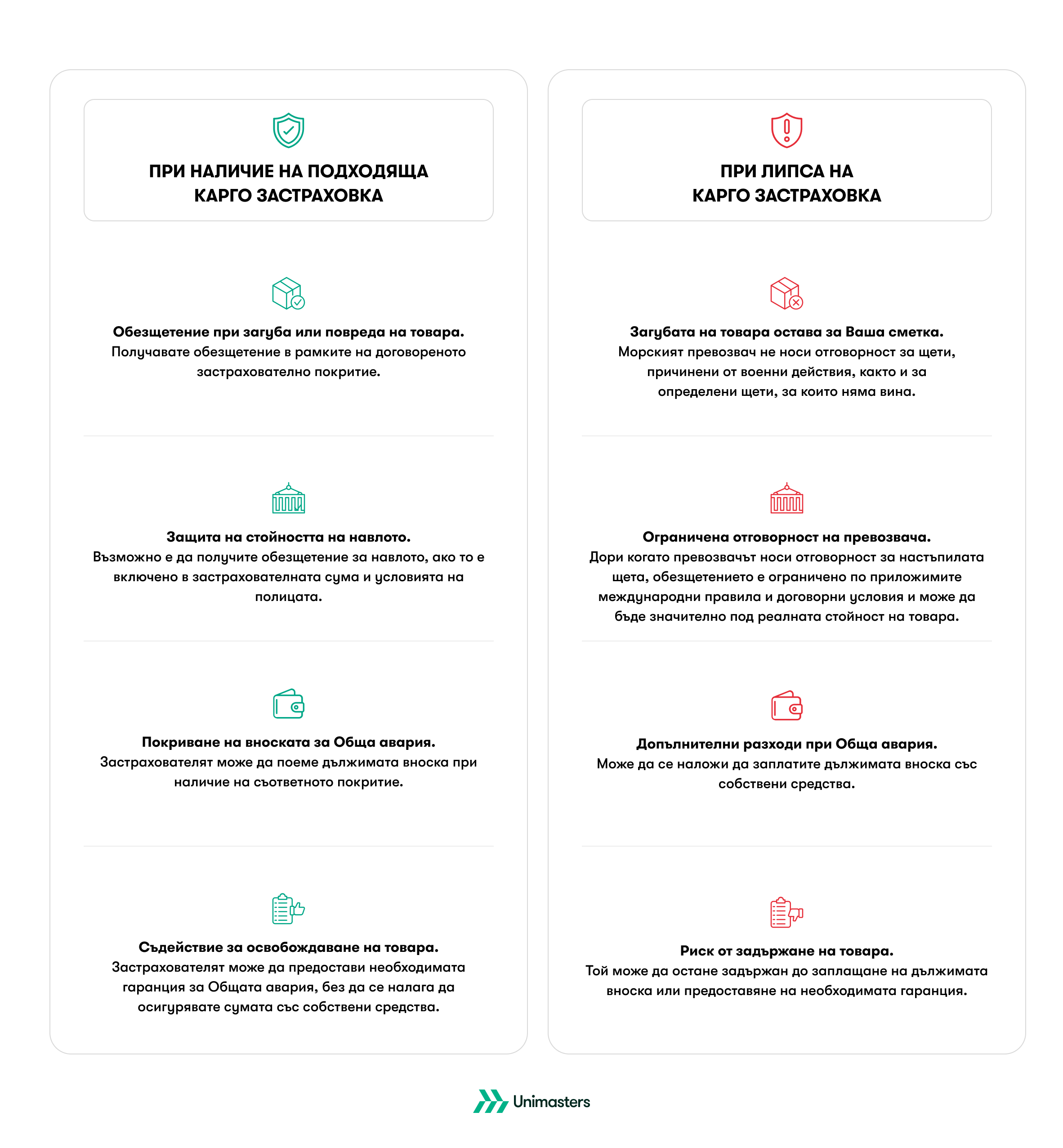
Even if your goods have been salvaged and show no visible damage, they may be held until the specified General Average contribution has been paid or the necessary guarantee has been provided.
This may result in unforeseen costs and a delay in receiving the goods.
Cargo insurance: why might standard cover not be enough?
Cargo insurance protects the financial interests of the owner of the goods in the event of loss or damage during transport, in accordance with the terms of the policy taken out. This cargo insurance applies in accordance with the specific terms of the policy.
It is important to bear in mind, however, that the standard Institute Cargo Clauses (A, B and C) contain exclusions for war risks. These may include damage caused by war, civil strife, torpedoes, floating mines and other acts of war.
This means that having standard cargo insurance does not automatically guarantee cover in the event of an incident in an area of heightened military risk. Therefore, when taking out cargo insurance, military risks must be checked separately.
What do we recommend?
When the cargo’s route passes through high-risk maritime areas, it is important to arrange additional cover for war risks - ‘War’ clauses (Institute War Clauses) – tailored to the specific route and the insurer’s current terms and conditions.
The combination of ‘All Risks’ and ‘War’ clauses can provide broader protection for the cargo, but only within the scope of the specifically agreed cover, limitations and exclusions. Additional cover for war risks is determined by the terms and conditions for the specific shipment.
Where the relevant clauses are in place, cargo insurance may cover:
Loss of or damage to the cargo resulting from an insured event;
The value of the freight, where this is included in the sum insured and the terms of the policy;
The general average contribution, including by providing the necessary guarantee for the release of the cargo.
Important: Cargo insurance does not automatically cover indirect financial losses that may arise as a result of the loss or delay of the cargo. Expenses incurred whilst awaiting delivery, loss of profit, penalties and other similar losses usually require separately agreed cover, where available.
With or without cargo insurance - what’s the difference?
In the event of a shipping incident in an area of heightened military risk, the financial consequences for the cargo owner may vary considerably.
6 important questions about cargo insurance for maritime transport across the Black Sea
1. Do standard cargo insurance policies cover military risks in the Black Sea? This distinction is important when insuring maritime cargo, particularly when military risks are under discussion.
Not automatically.
The standard Institute Cargo Clauses A, B and C exclude a number of war risks. To ensure cover when transiting through areas of heightened military risk, it is necessary to take out additional ‘War’ cover.
It is important to check whether the specific policy covers the relevant geographical area and whether there are any additional restrictions.
2. How do incidents and drone attacks in the Black Sea affect insurance premiums?
The increased risk is having an impact on insurance premiums.
The rise in attacks on merchant ships, including those taking place near the exclusive economic zones of Bulgaria and Romania, is leading insurers to assess the risk more highly.
This may result in an increase in insurance premiums for cargo and vessels, as well as the introduction of additional conditions for certain routes.
3. Does the ship’s exact route affect the cost of the insurance?
Yes, the route is a significant factor.
The insurance premium and the terms of cover may vary depending on the specific maritime zones through which the ship sails.
Territorial waters, exclusive economic zones and other specific maritime areas may be treated differently when assessing risk. Under certain conditions, sailing along routes closer to the coast may reduce risk exposure.
It is therefore important to take into account not only the starting and ending points of the voyage, but also the vessel’s actual route. For a route through the Black Sea, it is important to check whether the insurance covers war risk for the relevant maritime zones.
4. What does the 48-hour notice period mean in cargo insurance?
Insurance cover for war risks may be amended or terminated with 48 hours’ notice.
Certain insurance clauses grant the insurer the right to amend the terms or terminate cover for war risks under specific circumstances, subject to 48 hours’ prior notice.
In the event of a sudden escalation of the conflict, this may result in an additional premium if the insurer offers to continue the cover under new terms.
This is why it is important to check not only the initial terms of the policy, but also the possibilities for amending them during transit.
5. Who is liable for environmental damage and pollution in the event of a shipping incident?
Environmental damage is not covered by standard cargo insurance.
Liability for pollution of the marine environment caused by fuel or cargo is, in principle, covered by the shipowner’s liability insurance provided by P&I (Protection and Indemnity) clubs.
In the event of such incidents, the competent state authorities may make claims against the shipowner and their P&I club in accordance with the applicable international rules.
6. What is the difference between cargo insurance and the carrier’s liability?
These are two different defence mechanisms.
Cargo insurance - protection for the cargo owner
It is taken out in the interests of the owner of the goods and provides compensation in the event of loss or damage within the agreed scope of insurance cover. Depending on the terms and conditions included, compensation may be payable regardless of whether the carrier is at fault for the incident.
Liability of the maritime carrier - limited liability in respect of carriage
It is governed by the applicable international rules, national legislation and the terms of the bill of lading. The carrier’s liability is limited and does not cover all possible damages, including excluded war risks.
Therefore, the maritime carrier’s liability cannot replace cargo insurance.
What should you check before sending your parcel?
When planning sea transport across the Black Sea, we recommend that you consider the following five key issues:
Route: Does the vessel pass through areas of heightened military risk?
Insurance cover: Are ‘All Risks’ clauses and additional ‘War’ clauses included?
Geographical scope: Is the cover valid for all maritime zones along the route?
General average: Does the policy cover the relevant contribution and the provision of a guarantee for the release of the cargo?
Additional conditions: Are there any restrictions, notice periods or additional premiums in the event of a change in the risk profile?
Before departure, it is advisable to consult your insurer or insurance broker to confirm the scope and validity of the cover for the specific shipment.
Informed planning is part of ensuring the safety of your cargo
The heightened risk in the Black Sea calls for a more careful assessment at every stage of maritime transport – from route selection to the terms of insurance cover.
At Unimasters, we understand the importance of reliable organisation and advance planning in international logistics. Our team is on hand to assist you with sea freight solutions tailored to the specific nature of your cargo and your transport requirements. Find out more about our sea freight service: https://www.unimasters.com/freight-management/ocean
Contact the Unimasters team for further information and a personalised quote.
Note: This material is for information purposes only and does not constitute insurance or legal advice. The specific terms, cover, exclusions and limitations are determined by the relevant insurance policy and the applicable contractual and regulatory provisions.