

Origins: Where the 8,000 km Journey Begins
Series: 8,000 km in 45 Days: BESS Logistics from China to CEE
Current episode: Ep. 1 · Origin - Where the Journey Begins
Ep. 2 · At Sea - The Maritime Leg
Ep. 3 · At the Borders - Customs Clearance in CEE
Ep. 4 · Oversized - 43 Tonnes on the Roads of CEE
Ep. 5 · After Delivery - From Quay to Foundation
Ep. 6 · Insured? Cargo Insurance
The Situation
The shipment does not exist yet. The containers have not left the factory. The documents have not been prepared. This is the moment when the procurement manager makes a decision that will determine whether the project connects to the grid on time or misses its commissioning window. Episode 1 begins before the first container is loaded, at the point where planning either happens correctly or creates problems that will follow the project for the next 8,000 kilometres.
What You Are Really Dealing With
The journey of a BESS shipment from a factory in China to a construction site in Central and Eastern Europe (CEE) is not simply a logistics operation. It is a coordinated sequence of regulatory, documentary and operational steps, each dependent on the one before it.
Cargo Classification
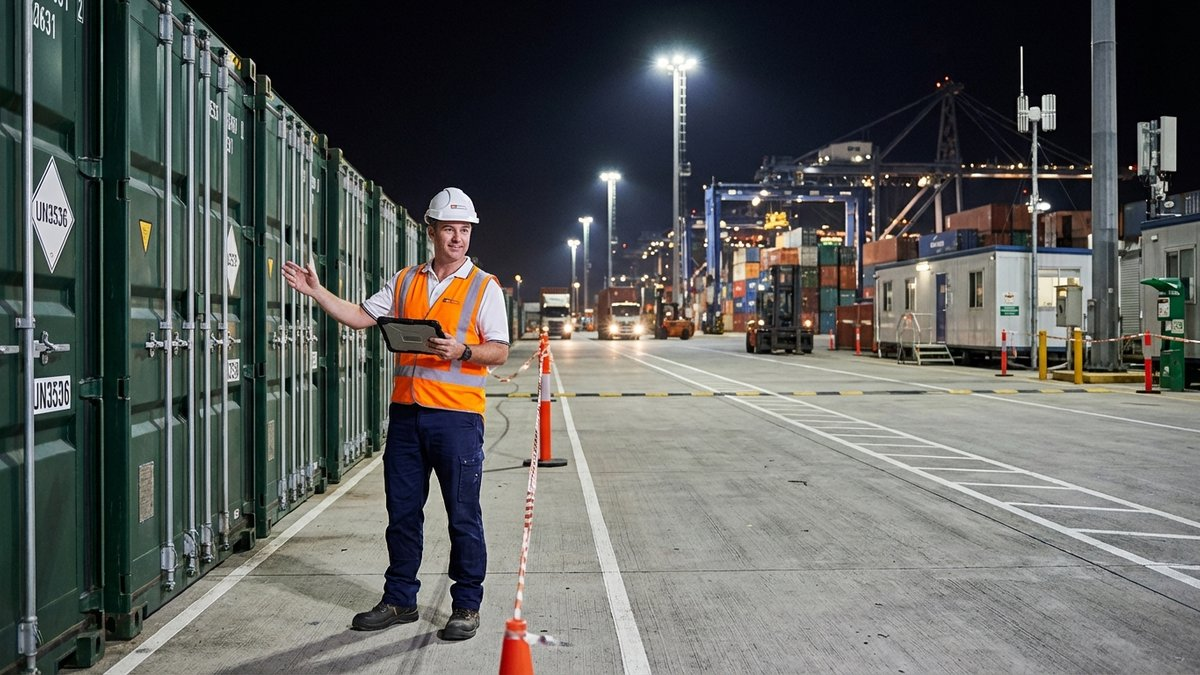
BESS containers are classified as Class 9 Dangerous Goods (DG) under the IMDG Code (International Maritime Dangerous Goods Code), Amendment 42-24, mandatory from 1 January 2026. The specific UN classification depends on the configuration:
UN3536: Lithium batteries installed in a cargo transport unit. This is the standard classification for BESS containers where the batteries are integrated into the container together with the BMS (Battery Management System).
UN3480: Lithium-ion batteries shipped on their own. Rarely applicable to BESS projects.
UN3481: Lithium-ion batteries packed with equipment or contained in equipment.
Under IMDG Code Amendment 42-24, UN3536 cargo is now assigned Stowage Category D, which means on deck only. This is a change from the previous Category A and has direct implications for booking vessel space.
Weight and Format
A typical BESS container is a 20-foot High Cube (20' HC) with a gross weight of 35–45 tonnes, most commonly around 43 tonnes. This is super-heavy cargo that requires particular attention when:
Booking vessel space, because carriers balance utilisation by both weight and container count.
Handling at terminals, where operators are always informed of the weight and use suitable equipment.
Moving by road, which requires abnormal-load permits in most European countries.
State of Charge (SoC)
Under IMDG Code 42-24 and industry practice, BESS containers should be transported by sea at a State of Charge of ≤30%. This reduces the energy available for thermal runaway and is a critical requirement that the manufacturer must guarantee before loading.
Manufacturer Documentation
OEMs (Original Equipment Manufacturers) routinely provide the full dangerous-goods documentation package:
UN38.3 Test Summary – results of lithium-battery safety testing.
MSDS/SDS (Material Safety Data Sheet / Safety Data Sheet).
Shipper's Declaration for Dangerous Goods.
Packing List – with weights and dimensions.
Commercial Invoice.
Certificate of Origin.
CE Declaration of Conformity – critical for import into the EU.
For visual context, Unimasters has documented the real execution of a delivery of 183 BESS systems from China to Bulgaria: 30 days by sea and 20 days to the final destination.
This case illustrates the scale and coordination required for successful BESS logistics.
The Timeline
Planning a BESS delivery requires a realistic assessment of the time from order placement to arrival at the construction site. Typical lead times for a project destined for Bulgaria or Romania are:
Stage\tTypical duration\tWhat determines the range
Production and preparation for shipment\t8–16 weeks\tOrder size, component availability, certification
Sea transport (China → Burgas/Constanța)\t28–65 days\tRoute (direct Suez vs. COGH with transshipment)
Customs clearance\t1–5 working days\tCompleteness of documentation, pre-filing
Inland transport to site\t1–5 days\tDistance, heavy-load permits
Critical clarification: the 28–65-day transit time is port-to-port. It does not include customs clearance or inland delivery to the construction site.
Sea Routes as of March 2026
As of March 2026, tensions in the Middle East have led most major carriers to maintain Cape of Good Hope (COGH) routing. However, niche carriers still transit the Suez Canal and offer faster options:
Direct Suez services: ~30–35 days to Constanța/Burgas, available but less frequent at around 1–2 sailings per month.
COGH routing via feeders from Piraeus or Turkish ports: ~55–70 days to Constanța/Burgas, selected for reliability and regularity of sailings.
Piraeus (Greece) and Istanbul (Türkiye) are the dominant transshipment hubs for the Black Sea. Tekirdağ (Türkiye) is an alternative used specifically by MSC.
Where Procurement Managers Consistently Underestimate
Stefan notes that most procurement teams underestimate three elements:
BESS booking windows: carriers limit accepted BESS volumes per vessel because of utilisation balancing, not because they are unable to carry the cargo. Booking 6–8 weeks in advance is the minimum for Q3–Q4.
Transshipment delays: during peak season (Q3–Q4), Piraeus can hold containers for up to 2–3 weeks before feeder transfer. Feeders to Black Sea ports generally sail once a week; a missed connection adds 3–7 days.
CE marking: CE-marking processes typically take 3–4 weeks. If the CE declaration is not available on arrival, customs can hold the cargo.
The Documents
At the pre-shipment stage, the following documents must be prepared and aligned:
From the manufacturer (OEM)
Document\tPrepared by\tCritical field\tCommon error
Commercial Invoice\tOEM\tHS code, value, Incoterms\tWrong HS code; batteries should be 8507.60.00.90
Packing List\tOEM\tGross weight per container\tDesign-spec weight instead of actual weighed weight
Certificate of Origin\tOEM/Chamber of Commerce\tCountry of origin\tMissing or unverified
UN38.3 Test Summary\tOEM\tTest date, results\tOutdated document
MSDS/SDS\tOEM\tChemical composition, SoC\tMismatch with the SoC declaration
CE Declaration of Conformity\tOEM\tApplicable directives, notified body\tMissing or incomplete
Shipper's Declaration for DG\tOEM\tUN number, class, packing group\tWrong classification, e.g. UN3480 instead of UN3536
From the freight forwarder/carrier
Document\tPrepared by\tCritical field
Bill of Lading\tOcean carrier or freight forwarder acting as contractual carrier\tWeight, which must match the VGM, and cargo description
VGM Declaration\tShipper/Terminal\tVerified Gross Mass – actual weighed weight
Booking Confirmation\tCarrier\tConfirmation of DG acceptance and deck space
Important note on the Bill of Lading: it is prepared by the ocean carrier or by the freight forwarder when acting as contractual carrier and issuing its own bill. It may be a physical document, especially where a Letter of Credit is used as a financial instrument, or electronic. The draft B/L is only for checking the data; the final version is issued by the carrier after approval.
Weight Discrepancies – a Common Source of Problems
Weight discrepancies arise between the Packing List and the Bill of Lading, not between the Commercial Invoice and the Packing List. The reason is that the manufacturer often enters weight in the Packing List based on standard or design specifications, while the VGM declaration, based on actual weighing after final securing, reflects the true weight and is used by the carrier for the Bill of Lading.
Solution: make sure the Packing List reflects the actually weighed cargo and is aligned with the VGM data before the Bill of Lading is issued.
What Goes Wrong
- Wrong UN classification
What happens: the procurement team declares the cargo as UN3480, standalone batteries, instead of UN3536, batteries installed in a cargo transport unit.
Why: the team does not understand the difference between classifications or copies documentation from a previous project with a different configuration.
Consequences: the carrier refuses loading or requires the documentation to be reworked. Correcting it and rebooking can add 5–10 days, plus storage charges at the export terminal.
Prevention: confirm the UN classification with the manufacturer before booking. UN3536 applies when the batteries are integrated into the container together with BMS and HVAC systems.
- SoC above 30%
What happens: BESS containers arrive at the export terminal with a State of Charge above 30%.
Why: the manufacturer has not discharged the batteries before shipment, or there has been a communication gap around the requirement.
Consequences: the carrier refuses loading. The containers may need to return to the factory for discharge, a process that can take 1–2 weeks. The sailing is missed, a new booking is needed and storage charges accrue.
Prevention: include SoC ≤30% as an explicit requirement in the supply contract. Require written confirmation from the manufacturer before loading.
- Missing or invalid CE declaration
What happens: the BESS equipment arrives at an EU port without a valid CE Declaration of Conformity, or with a declaration that does not cover the applicable directives.
Every supply chain decision carries the weight of thousands of miles.
Every supply chain decision carries the weight of thousands of miles.
Why: the CE process was not completed on time or the declaration was prepared for another market.
Consequences: customs holds the cargo until valid CE documentation is provided. Storage charges accrue. If CE compliance cannot be demonstrated, the cargo may be returned or destroyed.
Prevention: start the CE process at least 8 weeks before planned shipment. Confirm that the declaration covers Directive 2014/35/EU (Low Voltage), 2014/30/EU (Electromagnetic Compatibility) and the applicable harmonised standards.
- Weight mismatch between Packing List and Bill of Lading
What happens: the Packing List shows 41,500 kg while the VGM/Bill of Lading shows 43,200 kg.
Why: the manufacturer used design specifications in the Packing List rather than actual weighed weight. The VGM reflects the real weight after additional securing components were added.
Consequences: customs may request an explanation or corrected documentation. Clearance can be delayed by 1–3 days and, in some cases, penalties may apply for incorrect declaration.
Prevention: reconcile the Packing List with the VGM data before the Bill of Lading is issued. Require the manufacturer to provide actual weighed weights.
- Late documentation from the customer
What happens: the customs broker does not receive the complete document package in time for pre-filing the declaration.
Why: documents are sent piecemeal, with errors or at the last minute.
Consequences: customs clearance is delayed. Containers remain at the terminal and storage charges accumulate. The inland-transport window may be missed.
Prevention: send the complete document package to the customs broker at least 5 working days before the vessel's expected arrival. Use a documentation checklist.
What This Means for Your Project
Book sea transport 6–8 weeks before the planned loading date. Carriers limit BESS volumes per vessel because of utilisation balancing. In Q3–Q4 booking windows tighten further.
Confirm the UN classification with the manufacturer before booking. UN3536 requires Stowage Category D, on deck only, under IMDG Code 42-24. Wrong classification can lead to refusal to load.
Include SoC ≤30% as a contractual requirement. Require written confirmation from the manufacturer before shipment. This is not simply a recommendation; it is a transport requirement used by carriers and industry practice.
Start the CE process at least 8 weeks before planned shipment. The CE declaration is mandatory for import into the EU. Missing CE documentation leads to customs holds.
Align the Packing List with the VGM data before the Bill of Lading is issued. Weight mismatches are a common cause of customs delays.
What to Remember
BESS containers are typically 20' HC units weighing 35–45 tonnes, classified as UN3536 Class 9 DG and assigned Stowage Category D, on deck only, under IMDG Code 42-24.
Transit time from China to Burgas/Constanța is 28–65 days depending on route, direct Suez vs. COGH with transshipment. This is port-to-port and does not include customs or inland delivery.
SoC ≤30% is required for sea transport in practice. Confirm it with the manufacturer before loading.
The CE declaration is critical for import into the EU. Start the process 8 weeks before shipment.
Weight discrepancies between the Packing List and Bill of Lading are a common source of customs delay. Align the documents with VGM data.
Frequently Asked Questions
Q: What is the difference between UN3536 and UN3480 for BESS transport?
A: UN3536 applies to lithium batteries installed in a cargo transport unit, such as a container with integrated batteries, BMS and HVAC. UN3480 is for standalone lithium-ion batteries. For containerised BESS projects, UN3536 is the standard classification under IMDG Code 42-24.
Q: What is the maximum permitted State of Charge for sea transport of BESS?
A: Under IMDG Code 42-24 and common industry practice, BESS containers are transported at SoC ≤30%. This reduces the energy available for thermal runaway and is a critical condition the manufacturer should guarantee before loading.
Q: How long does sea transport from China to Burgas or Constanța take?
A: Transit time varies from 28 to 65 days depending on the route. Direct Suez services take around 30–35 days but are less frequent, around 1–2 sailings per month. COGH routing via feeders from Piraeus or Turkish ports takes around 55–70 days but offers greater regularity.
Q: What documents are required from the manufacturer for BESS shipment?
A: The minimum package includes Commercial Invoice, Packing List, Certificate of Origin, UN38.3 Test Summary, MSDS/SDS, CE Declaration of Conformity and Shipper's Declaration for Dangerous Goods. OEMs routinely provide this documentation to the ocean carrier.
Q: What is the HS code for lithium-ion BESS batteries?
A: The full HS code is 8507.60.00.90. PCS units, which are transformer/power-conversion stations, have a different HS classification and must be declared separately. The duty referenced in the source is 2.7% ad valorem for 8507.60.00.90.
Q: How long does customs clearance for a BESS import into Bulgaria take?
A: With complete documentation submitted in advance, customs clearance typically takes 1–5 working days. Delays occur where documentation is incomplete, tariff classification is wrong or weights do not match across documents.
Q: Why do weight discrepancies occur between the Packing List and Bill of Lading?
A: The manufacturer often enters weight in the Packing List based on standard or design specifications. The VGM declaration, based on actual weighing after final securing, reflects the true weight and is used by the carrier for the Bill of Lading. The solution is to align the Packing List with the VGM data before the Bill of Lading is issued.