

Oversized: When 43 Tons Meets CEE Road Infrastructure
Series
8,000 km in 45 Days: BESS Logistics from China to CEE
- Ep. 1 · Origin - Where the Journey Begins
- Ep. 2 · At Sea - The Maritime Leg
- Ep. 3 · At the Borders - Customs Clearance in CEE
- Current episode: Ep. 4 · Oversized - 43 Tonnes on the Roads of CEE
- Ep. 5 · After Delivery - From Quay to Foundation
- Ep. 6 · Insured? Cargo Insurance
The Situation
The containers have cleared customs in Burgas. The documents are in order, storage charges have not run longer than necessary, and the project manager receives the message: the cargo is ready for pickup. Now begins the final – and often most underestimated – leg of the journey: inland transport from the port to the construction site. For a 20-foot High Cube container with a gross weight of 43 tonnes, this is not a standard delivery. It is oversized transport of dangerous goods under ADR.
What You Are Really Dealing With
The Weight Reality
BESS containers are usually 20-foot High Cube units with a gross weight between 35 and 45 tonnes, most often around 43 tonnes. This places them in oversized-load categories in most Central and Eastern European countries, where the standard gross vehicle mass limit is 40 tonnes.
For comparison, a standard 20-foot container with consumer goods rarely exceeds 24 tonnes. A BESS container is almost twice as heavy, which changes everything from carrier selection to routing, permits and insurance.
Classification under ADR 2025
BESS units are classified as Class 9 dangerous goods. The applicable UN number depends on the configuration:
- UN3536: Lithium-ion batteries installed in a cargo transport unit, meaning the BESS container as an integrated unit.
- UN3480: Lithium-ion batteries when transported separately from equipment.
For BESS projects in CEE, UN3536 almost always applies because the batteries are integrated into the container together with the BMS (Battery Management System). The PCS (Power Conversion System) is a separate unit without a dangerous-goods classification.
Under the source's interpretation of ADR 2025 and the related maritime rules, UN3536 units require specific placarding on all four sides of the container: left, right, front and rear.
State of Charge (SoC)
The containers arrive from the maritime leg at SoC ≤30%. This is the transport condition used for the sea leg under IMDG practice. The source also carries the same ≤30% assumption into the road-transport planning stage. In practical terms, this is not a new planning issue because the batteries are already in that state when they arrive.
Oversized-Load Permits
In Bulgaria, oversized-load permits are handled through the road-infrastructure authorities. The source gives the following processing times:
- Category I, up to 44 tonnes total mass: 5–6 working days.
- Category II, 44–60 tonnes total mass: 6–8 working days.
For a typical 43-tonne BESS container loaded on a specialist tractor-trailer, the total combination mass usually exceeds 44 tonnes, which places the movement in Category II.
For transport across several countries, for example Romania → Bulgaria or Greece → Bulgaria, the lead time can extend to 8–12 working days because each country issues its own permit.
Critical point: the transport company arranges the permits, not the project team. The customer must ensure the carrier starts the process at least 7–8 working days before the planned delivery date.
The Timeline
Standard Scenario: Port → Site
| Stage | Duration |
|---|---|
| Customs clearance, perfect documentation | 1–3 working days |
| Organising inland transport | 2–3 working days |
| Oversized-load permit, one country | 6–8 working days |
| Physical transport, up to 500 km | 1–2 days |
| Total | 1–2 weeks |
For complex routes involving bridges, a difficult-to-access site or multiple countries, total lead time can reach 2–3 weeks.
Where Teams Underestimate
The most common mistake is assuming that once customs clearance is complete, the cargo can be on site “tomorrow”. The permit process follows established lead times and cannot simply be compressed.
The second mistake is planning the move without coordinating early with the carrier. The carrier needs the cargo's exact parameters – weight, dimensions and UN number – at least 10 days before the planned date so the permit application can be submitted on time.
The Documents
Documents for Road Transport of BESS
| Document | Prepared by | Format | Critical field |
|---|---|---|---|
| ADR transport document | Carrier | Paper or electronic | UN number, proper shipping name, hazard class |
| Oversized-load permit | Carrier through the relevant road authority | Paper | Route, validity, restrictions |
| T1 customs transit, when under customs control | Customs broker | Electronic | Final destination, completion deadline |
| Commercial Invoice | Manufacturer | Electronic | Value, cargo description |
| Packing List | Manufacturer | Electronic | Weight must match VGM |
Important: the UN38.3 certificate and MSDS/SDS are not road-transport documents. They are required for the maritime leg and are supplied by the manufacturer to the carrier at the port of origin. The source notes that Bulgarian customs rarely requests MSDS for BESS where the HS classification of the lithium-ion batteries is clear.
The Most Common Documentation Error
A weight mismatch between the Packing List and the Bill of Lading. The manufacturer often enters a design-specification weight in the Packing List, while the VGM declaration reflects the actual weight after final production and internal securing.
The solution is to ensure the Packing List reflects the actually weighed cargo and is aligned with VGM data before the Bill of Lading is issued. This is a procurement-team responsibility, not something to leave entirely to the carrier.
What Goes Wrong
1. Permit Application Started Too Late
What happens: the project team notifies the carrier three days before the desired delivery date. The carrier cannot obtain the permit in three days because the minimum lead time is 6–8 working days.
Why: insufficient coordination between procurement and the transport partner. Teams often assume “the carrier will sort it out”.
Consequences: the cargo remains at the port terminal. Storage charges accumulate from discharge, while the construction schedule is disrupted – the crane is booked and the site team is waiting.
Prevention: require the carrier to start the permit process 7–8 working days before the planned date and treat this as a project milestone.
2. Wrong Classification in the ADR Document
What happens: the ADR transport document shows UN3480 instead of UN3536, or omits the UN number entirely.
Why: the carrier has not been told that the cargo is an integrated BESS unit, or the procurement team supplied incomplete information.
Consequences: a roadside inspection can result in penalties and potential detention of the cargo. The source cites Bulgarian ADR fines starting at BGN 2,000 and reaching BGN 10,000 for repeat offences.
Prevention: give the carrier full cargo data: UN number, hazard class, gross weight and dimensions. Request a copy of the ADR document before loading.
3. Weight Mismatch at a Border Weighing Point
What happens: while transiting Romania, the vehicle is weighed at a border checkpoint. The measured weight is 800 kg above the weight declared in the permit.
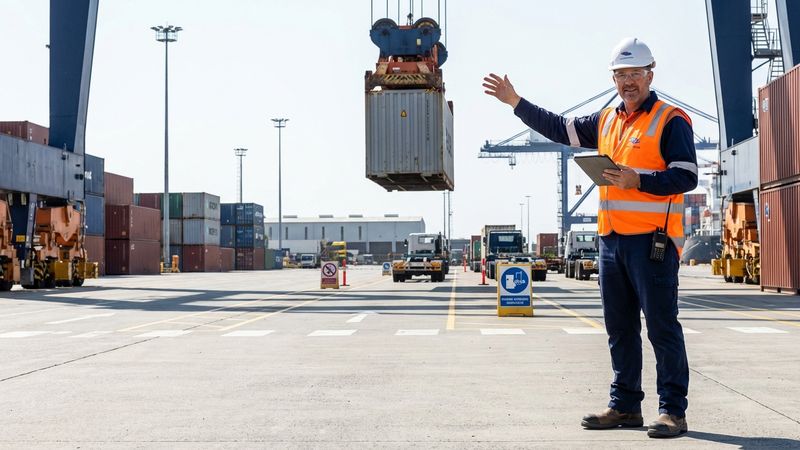
When infrastructure meets innovation, the weakest link determines project fate.
Why: the Packing List is based on design specifications rather than actual weighing. Additional securing elements added in production were not reflected.
Consequences: an overweight fine and potentially a requirement for a new permit with the correct data, adding days to the schedule.
Prevention: ensure VGM is based on actual weighing. Reconcile the Packing List with VGM before the Bill of Lading is issued.
4. Missing Container Placards
What happens: the container arrives without Class 9 placards on all four sides. The carrier refuses to move it.
Why: placards were applied for the sea leg but became damaged or detached.
Consequences: delay while replacement placards are sourced and applied. If the vehicle moves without them and is stopped, fines and detention may follow.
Prevention: inspect the placards during customs clearance. Ask the customs broker to confirm Class 9 placards are present on all four sides before inland transport is arranged.
5. An Unsuitable Heavy-Load Route
What happens: a permit has been issued for a specific route. The carrier decides to use a “shorter” alternative, but a bridge on that route has a 30-tonne restriction.
Why: no adequate route assessment or poor awareness of infrastructure limits.
Consequences: the vehicle cannot pass and must turn back and reroute, adding hours or a full day. Attempting to cross risks infrastructure damage and serious penalties.
Prevention: a route survey is especially relevant where bridges or difficult site access are involved. For straightforward motorway routes it may not be necessary. Confirm with the carrier whether the route contains critical points.
What This Means for Your Project
- Allow 7–8 working days for the permit before the planned delivery date. This is the minimum for one country. For multi-country transit, allow 10–12 working days.
- Give the carrier complete cargo data at least 10 days in advance: UN3536 for BESS, VGM gross weight, container dimensions and exact delivery address.
- Reconcile the Packing List with VGM before the Bill of Lading is issued. Weight mismatches are a major source of inland-transport problems.
- Check container placarding at customs clearance. Class 9 placards should be on the left, right, front and rear.
- Plan 1–2 weeks from customs clearance to site in a standard scenario. For complex routes, allow 2–3 weeks. Not 4–6 weeks, but not “tomorrow” either.
What to Remember
- BESS containers are typically 20' HC units weighing around 43 tonnes and fall into oversized-load categories across much of CEE.
- The carrier arranges the oversized-load permit, but the customer needs to trigger the process 7–8 working days in advance.
- The ADR transport document should show UN3536 for BESS units with integrated batteries. UN38.3 and MSDS/SDS are not the primary road-transport documents.
- Weight mismatch between the Packing List and VGM is a recurring documentation problem. Reconcile it before the Bill of Lading is issued.
- Class 9 placards should be present on all four sides of the container. Check their condition at customs clearance.
Frequently Asked Questions
Q: How long does an oversized-load permit take in Bulgaria?
A: The source gives 5–6 working days for Category I, up to 44 tonnes, and 6–8 working days for Category II, 44–60 tonnes. Multi-country transit can extend the process to 8–12 working days.
Q: Who arranges the oversized-load permit – the project team or the carrier?
A: The transport company arranges the permit. The customer should make sure the carrier starts at least 7–8 working days before the planned delivery and has complete cargo data.
Q: Which UN number is used for BESS containers in road transport?
A: UN3536 for lithium-ion batteries installed in a cargo transport unit. This is the usual classification for integrated BESS containers. PCS units are separate and do not carry the same DG classification.
Q: Is a route survey required for every BESS movement?
A: Not necessarily. It becomes particularly important where the route involves bridges, restricted infrastructure or difficult site access. Straightforward motorway routes may not require the same level of survey.
Q: What documents are needed for road transport of BESS?
A: The core set includes the ADR transport document, oversized-load permit and, where the cargo moves under customs control, T1 transit documentation, together with the Commercial Invoice and Packing List.
Q: What happens if the actual weight does not match the Packing List?
A: A roadside or border weigh-in may result in an overweight penalty and the need for a corrected permit. The preventive step is to align the Packing List with actual VGM data before the Bill of Lading is issued.
Q: On how many sides are Class 9 placards required?
A: The source specifies all four sides – left, right, front and rear – and recommends checking them again after the sea leg because placards can be damaged in transit.