

Shipping Lithium Batteries by Air: IATA Rules, UN Numbers and Documents for 2026

In short
• Lithium batteriescan be shipped by air if the shipment complies with the IATA Dangerous Goods Regulations (DGR) and the ICAO Technical Instructions, and the battery has passed UN 38.3 testing.
• The UN number depends on chemistry and configuration: UN 3480 and UN 3481 for lithium-ion, UN3090 and UN 3091 for lithium metal, UN 3551 and UN 3552 for sodium-ionbatteries.
• Lithium-ionbatteries shipped on their own (UN 3480) travel on cargo aircraft only, at a state of charge of no more than 30%.
• Since 1 January2026, the 30% state of charge limit is also mandatory for lithium-ion batteries packed with equipment (UN 3481, PI 966).
Lithium batteries are used across many sectors: from consumer electronics and electric vehicles to robotics and energy storage systems (BESS). China isthe world’s leading producer of lithium batteries, so importing batteries from China and shipping them internationally is an important part of global supply chains.
Despite their wide use, shipping lithium batteries requires special care. Because of the risk of fire and the release of hazardous gases, certain types of batteries are classified as Class 9 dangerous goods and are subject to specific requirements for transport, packaging and documentation. In this article we explain the rules for shipping batteries by air in 2026, which UN number applies and which documents you need.
What is thermal runaway and why is it a risk in air transport?
If damaged, short-circuited, overcharged or exposed to high temperatures, a lithium battery can undergo aprocess known as thermal runaway. This is an uncontrolled chain reactionin which the temperature rises sharply, gases are released and a fire canstart. On board an aircraft the consequencesof such an incident can be especially serious, which is why the rules for shipping batteries by air are among the strictest in transport. This risk requires strict compliance with the applicable safety requirements during transport.
Can lithium batteries be shipped by plane?
Yes. Lithium and sodium-ion batteries can be shipped by air when the shipment meets the applicable international requirements, including the IATA Dangerous Goods R egulations (DGR), the ICAO Technical Instructions and the UN 38.3 battery testing requirements.
The specific conditions depend on several factors:
• Battery type and chemistry: for example lithium-ion, lithium metal or sodium-ion.
• Rated energy or lithium content: in watt-hours(Wh) for lithium-ion and sodium-ion batteries and in grams of lithium forlithium metal batteries.
• State of charge (SoC): for certain categories of batteries a limit of 30% of rated capacity applies.
• UN 38.3 testing: the battery must have passed the tests, and the manufacturer must provide a summary of the results (UN 38.3 Test Summary).
• Packaging and marking: these must meet the applicable requirements.
• Shipment configuration: whether the batteries are shipped on their own, packed with equipment or installed in it.
Assessing these factors correctly is key to determining the permitted conditions for air transport.
The three configurations for shipping batteries by air
The requirements differ depending onhow the batteries are prepared for transport.
1. Batteries shipped on their own (UN 3480, UN 3090, UN3551)
The batteries are shipped separately from the equipment they are intended for. Depending on their type, stricter limits and specific requirements for packaging, documentation and permitted transport conditions may apply.
Lithium-ion, lithium metal and sodium-ion batteries shipped on their own are, as a rule, not accepted on passenger aircraft and travel on cargo aircraft only (CargoAircraft Only). For lithium-ion and sodium-ion batteries in this configuration, the state of charge must not exceed 30% of rated capacity.
2. Batteries packed with equipment (UN 3481, UN 3091, UN3552)
The batteries and the equipment are placed in the same outer packaging, but the batteries are not installed in thedevice. For this configuration, the requirements set for the relevant battery category and packing method apply.
Important change from 1 January 2026: lithium-ion batteries packed with equipment (PackingInstruction PI 966) must be offered for transport at a state of charge of no more than 30% of rated capacity. Until 2025 this was only a recommendation.
3. Batteries installed in equipment (UN 3481, UN 3091, UN 3552)
The batteries are installed in thedevice before it is shipped. The applicable limits and requirements depend on the battery type, the equipment and the specific configuration of the shipment.
For lithium-ion batteries installed in equipment (PI 967), the 30% state of charge limit remains a recommendation, not a mandatory requirement.
Distinguishing between these three configurations is important, because it determines the applicable rules fortransport, packaging, marking and documentation.
UN numbers for lithium and sodium-ion batteries
Correct classification is one of the first and most important steps in preparing batteries for air transport. It determines which transport requirements and procedures must be followed.
Under the UN classification, thefollowing identification numbers are used:
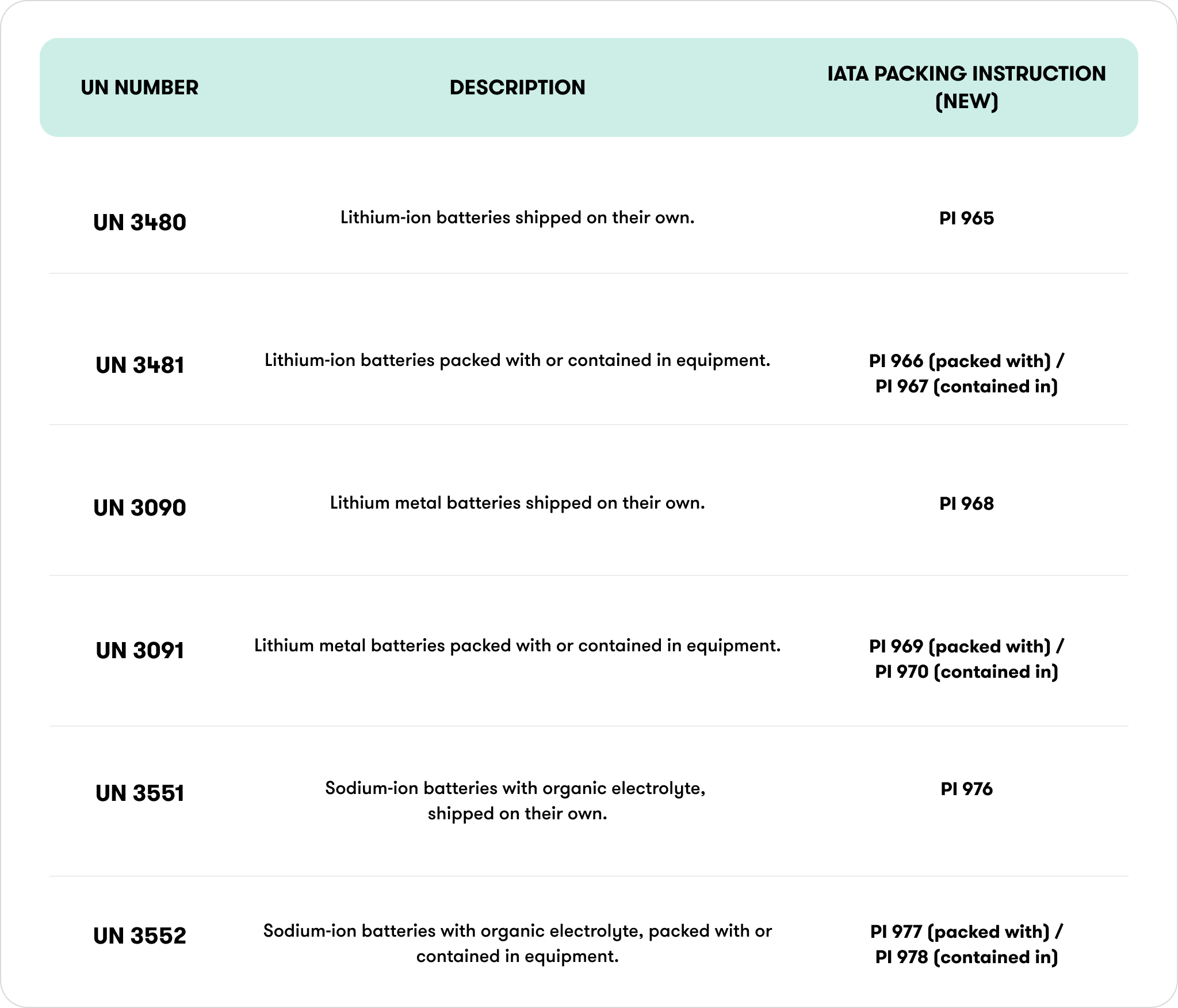
In air transport, these categories are handled under the applicable dangerous goods rules. The specific requirements depend on the classification, the characteristics of the batteries and the transport conditions.
Which documents and labels do you need to ship lithium batteries by air?
The exact set of documents depends on the UN number, the packing instruction and the section(Section I or Section II) the shipment falls under. The most commonly required are:
• UN 38.3 TestSummary, provided by the manufacturer.
• Safety Data Sheet(SDS), which airlines often request.
• Shipper’s Declarationfor Dangerous Goods, when the shipment falls under Section I of the relevant packing instruction.
• Class 9 lithium battery hazard label or lithium battery mark, depending on the section.
• “Cargo Aircraft Only” label, when the shipment cannot travel on a passenger aircraft.
• Air waybill (AWB)with the dangerous goods information entered correctly.
What changed for shipping batteries by air in 2026?
The 67th editionof the IATA Dangerous Goods Regulations (DGR) has been in force since 1 January2026. The main changes for batteries are:
• The 30% state ofcharge limit becomes mandatory for lithium-ion batteries packed with equipment(UN 3481, PI 966).
• The same limit applies to vehicles powered by lithium-ion or sodium-ion batteries.
• Sodium-ion batteries (UN 3551 and UN 3552), introduced into the rules in 2025, are shipped under their own packing instructions (PI 976, PI 977 and PI 978).
The regulationsare updated every year and each new edition takes effect on 1 January, so check the current requirements in the IATADGR before every shipment.
How does Unimasters organise air transport of lithium batteries?
Unimasters is an IATA cargo agent and a FIATA member. The company was founded in 1990 in Varnaand today has 18 offices in Bulgaria, Romania and Hungary and a partner networkin more than 180 countries.
Transporting batteries requires specialised expertise, precise preparation of documents and strict compliance with safety requirements.
The Unimasters Logistics team is certified to handle dangerous goods by air in line with IATA requirements. When organising export airfreight, we assist with preparing the required documentation, marking and labelling in line with the applicable IATA DGR requirements.
For import shipments, we work withour international partners and agents, who help check the documentation and packaging requirements in the country of origin. This allows us to assess the specific conditions of the shipment and coordinate a suitable transport solution.
If you are shipping energy storage systems, see also our BESS logistics service. For imports from outside the EU, we can also support youwith customs representation. Learn more about the types of air cargo in our article What Are the Different Types of Air Cargo?.
Frequently asked questions about shipping batteries by air
Can lithium-ion batteries be shipped on a passenger aircraft?
Lithium-ion batteries shipped on their own (UN 3480) are not accepted on passenger aircraft and travel on cargo aircraft only. Batteries packed with or installed in equipment (UN 3481) can also travel on passenger aircraft if the limits on quantity, packaging and marking are met.
What is UN 38.3?
UN 38.3 is aseries of eight tests from the UN Manual of Tests and Criteria that check whether a lithium battery is safe to transport: altitude simulation, thermal cycling, vibration, shock, external short circuit, impact and crush, overcharge and forced discharge. As a rule, a battery that has not passed the tests cannot be shipped by air.
What state of charge must a battery have for air transport?
No more than 30%of rated capacity for lithium-ion batteries shipped on their own (UN 3480) and, since 1 January 2026, for lithium-ion batteries packed with equipment (UN 3481,PI 966). For batteries installed in equipment, 30% is a recommendation.
How is a battery shipment from China to Bulgaria organised?
For imports, Unimasters works with international partners and agents in the country oforigin. They check the classification, documentation and packaging before the shipment is handed to the airline, which reduces the risk of rejection or delay.
What happens if a shipment does not meet the requirements?
The airline may refuse to accept the shipment, and non-compliance leads to delays and extra costs. That is why classification, packaging and documents are checked before the cargo is handed over.
Planning to ship lithium batteries by air?
Contact the Unimasters Logistics team and tell us more about your shipment. We will discuss its specific requirements and help you choose the right international transport solution.
For a faster assessment, send us: the battery type and chemistry, the UN number, the watt-hours (Wh), the quantity and weight, the shipment configuration and the route. Request a quote or call us on 0800 800 00.