

The Spares You Didn't Order
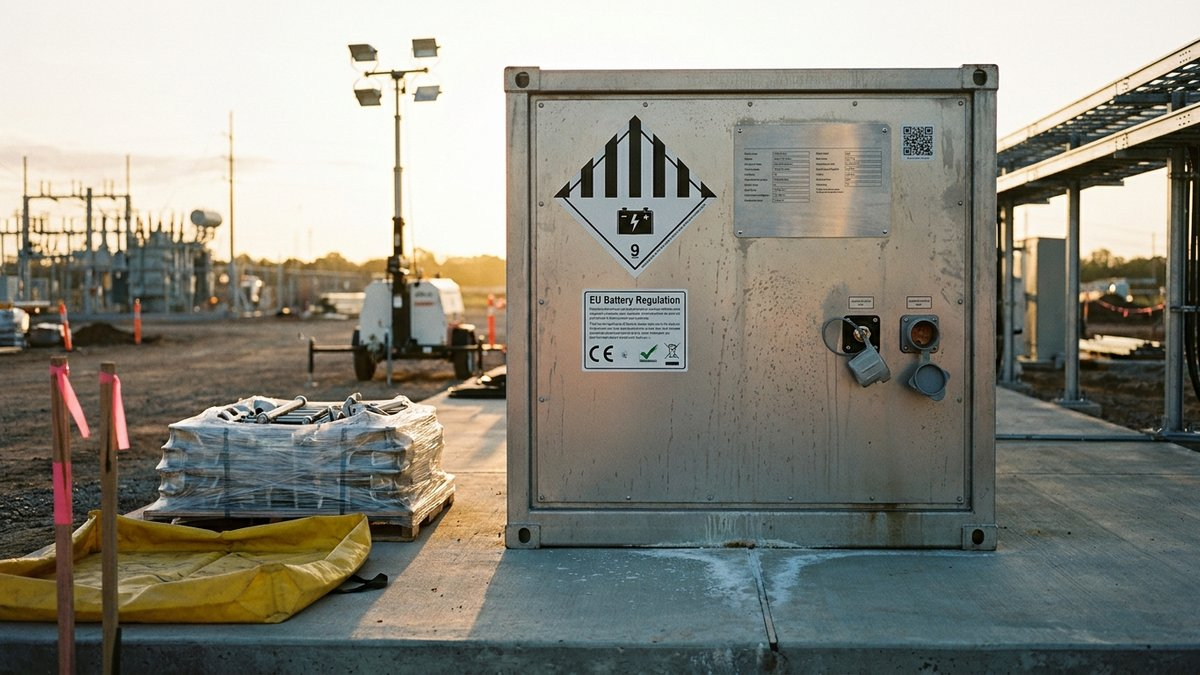
A battery module fails commissioning. The warranty says the manufacturer will replace it. What the warranty often does not say is who pays to return the defective unit to Asia, who carries end-of-life responsibility under EU Battery Regulation 2023/1542, and whether a spare module even exists in Europe. Those are not operational details; they are contractual gaps created when the supply agreement was signed without a spare-parts annex.
Series
The Buyer's Desk: Commercial Decisions That Define the BESS Project
- Ep. 1 · Payment Terms
- Ep. 2 · Who Pays for the Delay
- Ep. 3 · Importer of Record
- Current episode: Ep. 4 · Spare Parts - Warranty and Returns
- Ep. 5 · Storage or Flow
The Decision on the Table
BESS supply agreements usually contain a warranty clause but rarely a complete spare-module strategy. The commercial decision is who holds spare battery modules in Europe, who pays for them and who manages reverse logistics when a module fails commissioning or early operation.
The Main Options
Option 1: No Contracted Spare Stock
The buyer relies on the standard warranty. When a defect occurs, the manufacturer sends a replacement from the factory. For a full battery replacement from China, sea transit may take 55–70 days via COGH or 30–35 days on a less frequent direct Suez service. Smaller spare parts may be air-freightable if their size and dangerous-goods status allow it, but that should be confirmed contractually in advance.
Option 2: Consignment Spares in the EU
The manufacturer keeps an agreed number of spare modules in Europe. Ownership remains with the manufacturer until use. The buyer pays a premium or storage charge, but response time falls from months to days.
Option 3: Buyer Purchases Spares Up Front
The buyer orders additional modules, typically 2–5% of the total, with the initial shipment. The buyer owns and stores them, paying storage and insurance costs in exchange for full control of availability.
The Hidden Obligation
A warranty may promise replacement without allocating the cost and responsibility of returning a defective module, preparing dangerous-goods documentation or deciding whether the unit is a repairable product or waste.
Who Is the “Producer” under EU Battery Regulation 2023/1542?
For direct imports from China, the EU-established importer may become the entity carrying EPR obligations. That can include registration, collection and recycling responsibilities and therefore affects warranty returns and end-of-life treatment.
Transporting Damaged or Defective Class 9 Cargo
Damaged, defective or recalled lithium batteries do not move under the same conditions as new modules. ADR 2025 and IMDG 42-24 impose additional documentation, packaging and, in some cases, competent-authority requirements. Carriers may refuse the cargo until the condition is fully documented.
If the contract says “return first”, the buyer can be forced to organise and fund that complicated movement before the replacement is released.
Spare Stock in the EU
Where spares are held in Germany, the Netherlands or Poland, the contract should clarify ownership transfer and where the modules are first placed on the market, because that affects EPR responsibility.
What Happens to the Defective Module?
Depending on condition, the module may be repaired, repurposed for second life or classified as waste. If it becomes waste, cross-border shipment can trigger waste-shipment rules, notifications and financial guarantees.
What It Costs When Things Go Wrong
The source models a project where three modules fail commissioning and the contract requires the defective units to be returned before replacements are released.
- Weeks 1–2: manufacturer confirms warranty and demands return first.
- Weeks 3–4: the EPC team searches for a carrier willing to accept defective lithium batteries.
- Weeks 5–6: manufacturer provides required condition documentation.
- Weeks 7–15: defective modules travel back to China and replacements are dispatched.
- Weeks 16–24: replacements travel back to Europe.
- Weeks 25–26: customs clearance and inland transport.
Total: up to 26 weeks in the full-battery replacement scenario, with the system operating at reduced capacity during the delay.
With consignment spares in Europe, the replacement can arrive in roughly 5–7 days while the defective units move back in parallel.
What to Agree before Signing
- Define “ship and return” versus “return first”.
- Allocate who organises and pays for reverse transport.
- Require the manufacturer to provide defective-battery transport documentation within a fixed response period.
- Allocate EPR responsibility and require proof of relevant registrations or authorised representation.
- Agree an EU spare-module solution: consignment stock or buyer-owned spares.
From the forwarder:
- Obtain a reverse-logistics procedure and indicative timings for defective modules.
- Confirm whether EU storage of spare modules can be arranged.
What to Remember
- A warranty promise alone does not define reverse-logistics cost or timing.
- The EU importer may carry EPR obligations for batteries placed on the market.
- Damaged or defective lithium batteries need special ADR/IMDG handling.
- EU consignment stock can reduce replacement lead time from months to days.
- Ownership-transfer and market-placement timing should be explicit for spare modules.
Frequently Asked Questions
Q: Who is the producer for a directly imported BESS battery?
A: In many cases, the EU-established importer placing the battery on the market carries the relevant producer/EPR obligations.
Q: How long can a warranty replacement take with no EU spare stock?
A: The source's full return-first scenario reaches as much as 26 weeks.
Q: What is special about transporting defective lithium batteries?
A: They require additional condition documentation, compliant packaging and potentially authority approval under ADR/IMDG rules.
Q: What does consignment stock mean?
A: The manufacturer keeps spares in the EU while retaining ownership until a module is used, giving the project fast access without buying all stock up front.
Q: What spare percentage is reasonable?
A: The source cites 2–5% depending on project scale and warranty structure.
Next episode