

When the Documents Don't Match: A BESS Logistics Compliance Case Study
Series
IMDG/ADR Decoded: The Regulatory Guide to BESS Transport
- Ep. 1 · Class 9 - Dangerous Goods Classification
- Ep. 2 · The Documents - The Complete Transport Package
- Ep. 3 · IMDG 42-24 / ADR 2025 - What Changed
- Current episode: Ep. 4 · Case Study - When Documents Don't Match
When Documents Don't Match: Anatomy of a Detained BESS Shipment
The Shipment That Did Not Move for 14 Days
A detailed look at how documentation inconsistencies, classification errors and regulatory mismatches create real delays for BESS shipments – and how to prevent them.
What the Rules Require
This episode examines the intersection of the two regulatory regimes governing BESS transport: IMDG Code Amendment 42-24 for sea transport and ADR 2025 for road transport in Europe. The source treats lithium-ion BESS containers under UN3536: lithium batteries installed in a cargo transport unit, Class 9 dangerous goods.
The authoritative texts are published by IMO and UNECE.
The case illustrates what happens when the documents are not fully aligned between the sea and road stages. The difference between theoretical compliance and inspection-ready documentation determines whether cargo moves or sits.
When Paperwork and Reality Diverge
A BESS shipment of 12 containers manufactured in Asia is destined for a 60 MW CEE project. The route is sea transport to a South-Eastern European port followed by road transport to the construction site. On paper everything appears correct: the documents are complete and the classification looks right. At inspection, however, several inconsistencies emerge and create a 14-day standstill.
The Cascade of Errors
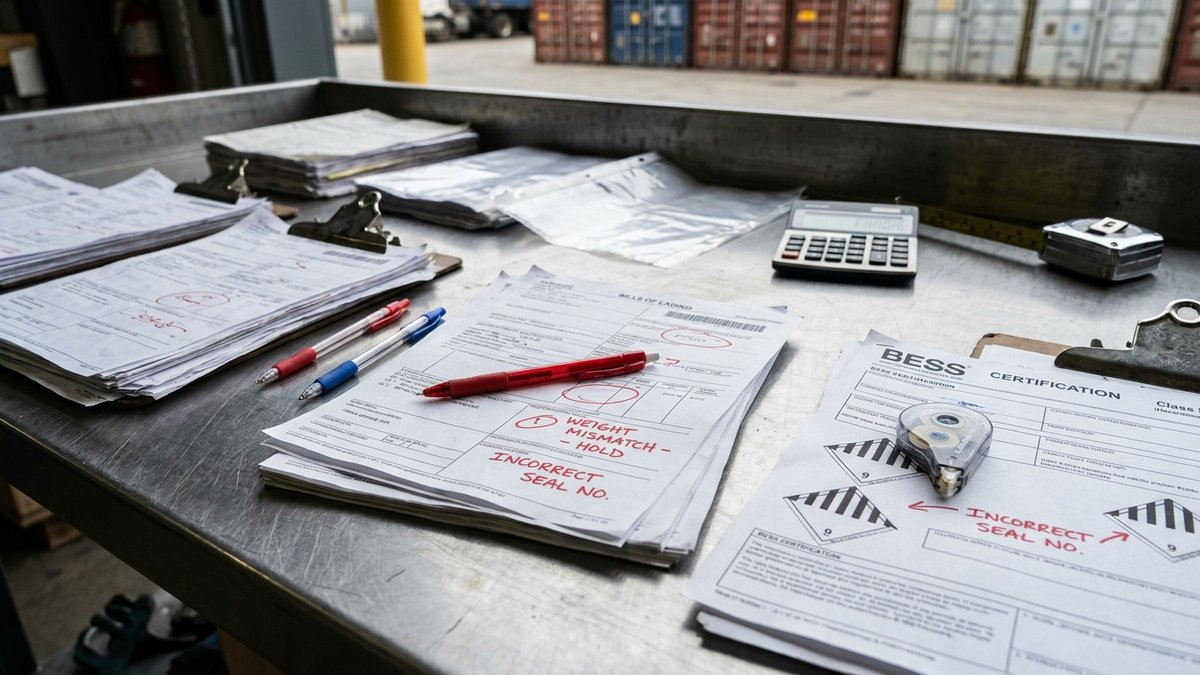
Scenario 1: Weight Discrepancy – 8 Working Days Instead of 1
Situation: 180 BESS containers for a 230 MW project arrive in Burgas. Packing Lists show 42,500 kg per container while the Bill of Lading shows 43,300 kg.
What happened: customs flagged the mismatch and asked the importer and broker for an explanation. The importer went back to the manufacturer. The manufacturer confirmed that the Packing List used design specifications while VGM reflected actual weight after additional securing was installed during production.
Result: seven working days to obtain a corrected Packing List and receive customs approval. Total clearance: eight working days instead of one.
Consequences: terminal storage charges accumulated from discharge, inland transport had to be rescheduled and commissioning milestones came under pressure.
Prevention: make the Packing List reflect actual weighed cargo and reconcile it with VGM before the Bill of Lading is issued.
Scenario 2: Wrong UN Classification – Refusal to Load
Situation: BESS containers are declared as UN3481 rather than UN3536.
What happened: the carrier refused loading because the classifications trigger different transport and stowage requirements. Documentation had to be corrected at origin.
Result: the sailing was missed. The next sailing was seven days later, resulting in around 10 days of delay.
Consequences: a missed feeder connection in Piraeus added another week, taking total origin-to-destination delay to roughly 17 days.
Prevention: verify the UN classification with the DG specialist before booking. For integrated BESS units whose principal function is to supply external systems, the source uses UN3536.
Scenario 3: Missing Placarding on Four Sides
Situation: BESS containers arrive with Class 9 placards only on the left and right sides instead of left, right, front and rear.
What happened: the Shanghai terminal recorded the non-conformity. The carrier would not load the containers until the markings were corrected.
Result: three working days to organise additional terminal marking plus a seven-day schedule slip because the sailing was missed.
Consequences: extra marking and storage charges, followed by a later sailing at a higher price.
Prevention: inspect markings before the containers reach the port. The source requires Class 9 placards and UN-number markings on all four sides.
Scenario 4: SoC Declaration without a Specific Value
Situation: the State of Charge declaration says only “SoC is within acceptable limits” rather than giving a specific value.
What happened: the carrier requested a specific percentage before accepting the cargo. The manufacturer had to issue an updated declaration, for example “SoC: 28%”.
Result: two working days of delay at origin.
Prevention: provide the explicit SoC value required by the carrier rather than generic wording.
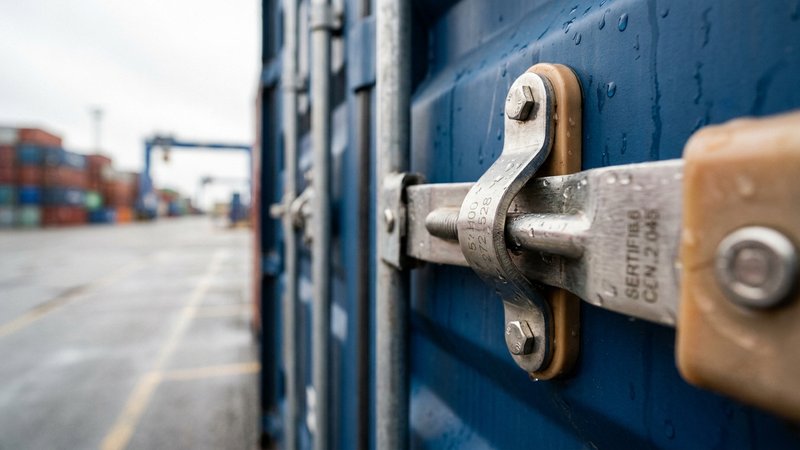
A small seal can stop a multimillion-dollar cargo. The moment a shipment is detained.
Lessons from 14 Lost Days
The source states that IMDG 42-24 / SP389 places UN3536 BESS units in on-deck-only Stowage Category D and applies separation from living quarters. This reduces slot availability and makes accurate classification essential.
Weight discrepancies between Packing List and Bill of Lading are among the most common reasons for BESS customs holds in the source's CEE workflow. The practical solution is to update the Packing List to actual VGM data before the B/L is issued.
Placarding is required on all four sides in the source's checklist. Two-sided marking is not sufficient.
With perfect documentation, the source allows 1–3 working days for customs clearance. With documentation problems, it can reach 10 working days. A seven- to nine-day difference can threaten commissioning windows.
The source uses HS code 8507.60.00.90 for lithium-ion BESS batteries and notes that PCS equipment has a separate classification and should be declared separately.
Documentation inconsistencies are quiet schedule killers. A customs delay that appears small on paper can combine with a missed feeder and rescheduled inland transport to create a three-week project impact.
For projects with fixed grid-connection dates, prevention is straightforward but disciplined: verify the documents before loading, not after arrival.
The practical lesson is simple: ask the manufacturer whether the Packing List reflects actual weighed cargo and matches the VGM data.
Frequently Asked Questions
Q: What is the difference between UN3536 and UN3480 for BESS containers?
A: UN3536 is used in the source for lithium batteries installed in a cargo transport unit where the integrated system supplies external equipment. UN3480 is for standalone lithium-ion batteries.
Q: How long does customs clearance of a BESS shipment in Burgas take?
A: The source gives 1–3 working days with perfect documentation and up to 10 working days when there are document problems.
Q: On how many sides are Class 9 placards required?
A: Four sides – left, right, front and rear – in the source's checklist.
Q: What State of Charge information should be declared?
A: The source recommends a specific value rather than generic language such as “within acceptable limits”, because carriers may require an explicit percentage.
Q: Who arranges oversized-load permits for the inland leg?
A: The road carrier. The customer should make sure the process starts around 7–8 working days before the planned delivery.
Q: What happens if Packing List weight does not match the Bill of Lading?
A: Customs can request an explanation and corrected documentation, adding several working days to clearance.
Q: Do I need a Greek EORI if cargo transits Piraeus?
A: It depends on the customs procedure. Under T1 transit, final clearance can take place in the destination country; fiscal clearance in Piraeus may require a Greek setup or fiscal representative.